Movi(e)ng Letters: Voicing Private Correspondence from Graeco-Roman Egypt to Brazilian Cinema

by Eleonora Cattafi

Visiting researcher@Universidade de São Paulo

In the 1990s, at the Central Station of Rio de Janeiro, Brazil, a retired teacher named Dora spends her days writing letters on behalf of dozens of illiterate people. It sounds like the beginning of a movie, and it is (Central do Brasil, 1998). In another Brazilian film, A Vida Invisível (2019, free adaptation of the 2016 novel A Vida Invisível de Eurídice Gusmão by Martha Batalha), two sisters, Eurídice and Guida Gusmão, separated by circumstances and family decisions in the 1950s, continue to search for one another through letters exchanged across the years, which, however, never reach their intended addressees.

In both movies, starring an icon of Brazilian cinema, Fernanda Montenegro, epistolary practices function not merely as a narrative device, but as a thematic and structural core. These cinematic representations, together with the presence of a large corpus of private papyrus letters from Graeco-Roman Egypt, invite reflection on the acts of dictating, writing, delivering and receiving letters in Antiquity and modern times.


Dora the scribe

Private letters on papyrus were commonly dictated to a scribe, who could also be a family member or an acquaintance, although cases of autograph letters from Graeco-Roman Egypt are not absent. Both scenarios are portrayed in the films: in A Vida Invisível, Eurídice and Guida pen their own letters, while the presence of a mediator between oral and written form characterises Central do Brasil.

Central do Brasil (1998)

At the beginning of the movie, Dora is depicted as a professional scribe-like figure, with her own small scribal office inside the train station: she interacts with a variety of people in terms of age, gender, and personal situations, writing letters dictated to her in exchange for a small fee. Moreover, as in papyri, Dora makes sure to ask and incorporate the address of the recipient, once annotating instructions to reach the addressee: “terceira casa depois da padaria (third house after the bakery), Mimoso, Pernambuco”, as in the σημασίαι typically found in papyri (cf. σημασσία ἐν Τευμενοῦτει ἐν τῷ ῥυμείῳ ἀντεὶ τοῦ φλητρος, P.Oxy. ΧIV 1678, address, at the Teumenos quarter in the lane opposite the well).

The drafting process is negotiated and participative: in one case, Dora helps a client to find the right term; in another, a woman explicitly asks her how to best formulate a section of the letter because “she has experience”. This resonates with corresponding epistolary practices in modern day countries, as well as with what we presume was the situation in Ancient Egypt (Verhoogt 2009), although, in the latter case, the figure of a female professional scribe like Dora would have been unusual, as women were less likely to be literate compared to men.

In the letter which will activate the plot of the road movie, a woman dictates to Dora a reproaching letter to Jesus, the father of her child Josué: “Jesus, você foi a pior coisa que já me aconteceu… vê se pelo menos aparece pra conhecer teu filho”. (Jesus, you were the worst thing that ever happened to me… at least show up to meet your son).

The letter as an instrument of accusation and a demand for responsibility to a defaulting father finds a parallel in a papyrus (UPZ I 59) sent from Isias to Hephaistion in 168 BC, where absence is framed as material abandonment of the family: ἐπὶ δὲ τῶι μὴ παραγίνεσθαί σε [π]ά[ντ]ων τῶν ἐκεῖ ἀπειλημμένων παραγεγο[νό]τω\ν/ ἀηδίζομαι ἕνεκα τοῦ ἐκ τοῦ τούτο\υ/ καιροῦ ἐμαυτήν τε καὶ τὸ παιδίο[ν σ]ου διακεκυβερνηκυῖα καὶ εἰς πᾶν τι ἐληλυθυῖα διὰ τὴν τοῦ σίτου τιμὴν καὶ δοκοῦσα νῦγ γε σο\ῦ/ παραγενομένου τεύξεσθαί τινος ἀναψυχῆς, σὲ δὲ μηδʼ ἐντεθυμῆσθαι τοῦ παραγενέσθαι μηδʼ ἐνβεβλοφέναι εἰς τὴν ἡμετέραν περί\στασιν/ (but about your not coming home, when all the others who had been detained there have come, I am ill-pleased, because after having piloted myself and your child through such bad times and been driven to every extremity owing to the price of wheat, I thought that now at least, once you got home, I would enjoy some rest. But you have not even thought about coming home, nor given any regard to our situation).

Interestingly, in the specific case of Josué, Dora will assume at the same time the role of the scribe and of the courier of the letter, trying to fill both the gap between spoken and written discourse, and the physical gap with the recipient. Her aim to deliver the letter and escort the boy to meet the rest of his family will result in a long journey across the country, but we might even observe that the movie itself is constructed as a letter in motion: opening with the word “querido” (dear), it unfolds in an arduous search for an absent addressee, whereas the narrative arc of the main character Dora shifts from cynical detachment and mediation to authorship and personal involvement.


Lost sisters and lost letters

In A Vida Invisível, Guida sends letters to her sister describing different aspects of her everyday life, which are comparable to the topics we regularly find in women’s letters on papyrus (Bagnall and Cribiore 2006). For instance, she gives news about the birth of her son Francisco (cf. καὶ εἰ ἔτυχέν με γεννῆσαι ἄρενα τὸ ὀνασοῦ ἀτελφοῦ ὠνόμαζον, P.Mil. II 84, If I had happened to give birth to a male, I would have given it my brother’s name), about the health of a friend (cf. εὐχαριστῶ μὲν τοῖς θεοῖς <ὅτι> τὸν νοῦν ⟦  ̣⟧ αὐτο\ῦ/ [κ]α̣[ὶ] τὴν ὑκία\ν/ ἀτοῦ πάλιν ἔσχηκε , SB V 8027, We are thankful to the gods that he has recovered his mind and his health), and about her job (cf. μόγις ἔλαβον ἀπὸ τοῦ βαφέος τ[ῆι] ι τοῦ Ἐπείφ. συνεργάζομαι δὲ ταῖς παιδίσκαις σου κατὰ τὸ δυνατόν, P.Brem. 63, I at last got the material from the dyer on the 10th of Epeiph. I am working with your slave girls as far as possible).

The central, recurring issue of Guida’s writing, however, is her strong desire that her letters will reach Eurídice, although she is starting to lose hope that an answer from her sister will ever reach her: “Continuo esperando suas cartas que nunca chegam” (I keep waiting for your letters that never arrive).

Complaining and worrying about lack of contact constitute also important topoi of private papyrus letters (Clarysse 2017). For instance, in P.Leid.Inst. 42, Heras writes to her sister Taphes, underlying the absence of reaction to her letters: γνόσι δὲ ὅ̣[τι δί]ς̣ σ̣υ̣ ἔγ̣ραψα καὶ οὐκ ἀντ̣[ὶ μιᾶς] τῶ̣ν ἐπειστωλο͂ν μ̣[οι ἔγρα]ψες (You should know that I have written to you twice and you have not written to me in answer to any of the letters).

P.Mert. II 82

In another letter (P.Mert. II 82) exchanged between sisters, Nike and Berenike, the former is worried that her letters were not delivered: [Νεί]κ̣η Βερενείκηι τῆι [κυ]ρ̣ίᾳ ἀδελφῆι πλεῖστα χαίρειν. π̣ρ̣ὸ̣ μὲν πά[ν]των εὔχομαί σε ὑγιαίνειν καὶ ἀ̣ε̣ί σου τὸ προσκύνημα ποιῶ παρὰ το[ῖς] ἐνθάδε θεοῖς εὐχομ̣έ̣ν̣η σοι τὰ ἐ̣ν βίῳ ἀγαθὰ ὑπαρχ̣θ̣ῆ̣ναι. ἔγρ̣α̣ψά σ̣ο̣ι̣, κυρία ἀδελφή, ἄ̣λ̣λα δὶς χω[ρ]ὶς̣ τού<του> καὶ τάχα σοι οὐ[κ ἀ]ν̣εδόθη (Nike to Berenike her lady sister, many greetings. Before all I pray that you are well, and I constantly perform your obeisance before the gods here, praying that you may have life’s good things. I wrote you, lady sister, two other times besides this, and perhaps they were not delivered to you).

The uncertainty of delivery is therefore explicitly acknowledged within the letter, both in this papyrus and in the movie, where Guida shares the concern, which at some point becomes awareness, that her letters never left Brazil. In A Vida Invisível, however, the distance that the letters seek to reduce is social much more than geographic, being caused by the same family obstructions which will also determine the lack of success of the epistolary transmission. The Gusmão sisters ignore that they are living in the same city: while both sending their letters from Rio de Janeiro, they think those will reach Austria and Greece, respectively.

 

Central do Brasil (1998)

An element of intentionality in the failure of communication appears also in Central do Brasil: Dora does not deliver on purpose some of the letters that were dictated to her, either by tearing them up among laughter with her friend Irene, or by condemning them to a purgatory of indefinite waiting in her own drawer.

In both movies, epistolary communication fundamentally lacks reciprocity: as in papyri, where we do not have complementary parts of epistolary exchanges preserved, excluding a couple of exceptional cases (cf. Amory 2022: 235), we are only able to see one side of the conversation.


Ending a letter with saudade
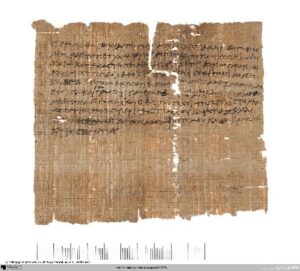
Chrest.Wilck. 100

A certain Serenilla, in a letter from the Roman period (Chrest.Wilck. 100) which is probably autograph, writes: γεινώσκειν σε θέλω ὅτι μόνη ἰμὶ ἐ̣γ̣ώ̣. ἐν νόῳ ἔχῃς ὅτι ἡ θυγά[τ]ηρ μου ἰς Ἀλεξάνδρειαν ἐσσὶ, ἵνα κα̣ι\γὼ/ εἰδῶ ὅτι πατέρα ἔχω εἵνα μὴ ἴδωσείν με ὡ̣ς μὴ ἔχουσαν γονεῖς (I want you to know that I am alone. Keep in mind, “My daughter is in Alexandria,” so that I may know that I have a father, so that they may not see me as someone without parents).

At the end of Central do Brasil, while Josué finds unexpected ways to reconnect with his family, an emotional Dora sends a personal note to the boy, closing her story with the words: “Tenho saudade do meu pai, tenho saudade de tudo” (I miss my father, I miss everything). She conveys her message in the form of a letter precisely because she is going away: only the longing on the solitary bus ride towards home makes the possibility of writing her only non-dictated letter a structural necessity.

Complementarily, at the end of A Vida Invisível, an old and visibly moved Eurídice finds the epistolary corpus of her sister, which allows her to finally reconstruct the “invisible life” they lived hidden from each other. For Eurídice, the lateness of the revelation unmasks the fragility of reading private correspondence, echoing the very definition of a letter as “a kind of written conversation with someone from whom one is separated”, formulated in Antiquity by Pseudo-Libanius (Charact. Epist. 2): since Guida’s first message, announcing she is leaving for Greece, the presence of the letter has always implied the absence of the person, first in space, and later, irreversibly, in time.

A Vida Invisível (2019)

As readers of today, the nosy, unintended audience of papyrus letters two thousand years after their composition, we too can now reconstruct in absentia, across many silences, the lives of Egyptian people on the basis of their documentary texts.

In the last letter voiced on screen, Guida expresses her unrealisable wish to be able to go back in time so that she and her sister could meet again: a medium of human connection, private correspondence always operates in the domain of absence, which is the realm of saudade.


References

Aïnouz, Karim, dir. A Vida Invisível. 2019.

Amory, Yasmine. 2022. When the letter speaks up: living and lifeless letters. In Arthur-Montagne Jacqueline, Scott J. DiGiulio and Inger N.I. Kuin (eds.). Documentality: new approaches to written documents in imperial life and literature, 233-250.

Bagnall, Roger and Raffaella Cribiore. 2006. Women’s Letters from Ancient Egypt. 300 BC-AD 800. Ann Arbor.

Clarysse, Willy. 2017. Emotions in Greek private papyrus letters. Ancient Society 47, 63-86.

Luiselli, Raffaele. 2008. Greek Letters on Papyrus First to Eight Centuries: a Survey. In Grob, Eva M. and Andreas Kaplony (eds.). Documentary Letters from the Middle East. Bern, 677-737.

Salles, Walter, dir. Central do Brasil. 1998.

Verhoogt, Arthur. 2009. Dictating Letters in Greek and Roman Egypt from a Comparative Perspective.
Making sense of verb-noun collocations in Postclassical Greek

by Lucía Madrigal Acero

Visiting PhD fellow


We use collocations everyday without really noticing them. We wake up, take the bus to work and sit down at our desks. Sometimes, we are required to make decisions and take responsibility and, when we are exhausted, we need to take a break. After having lunch, we will work a few more hours and go home to our children doing homework. In the late evening, once we have taken notice that everything is alright, we will go to bed and have a good night’s sleep.

Collocations are a multi-faceted aspect of language. To begin with, they lie in the syntax-semantics interface, which accounts for their specific behaviour (Baños et al., 2022; Fendel, 2024). From a diachronic perspective, they undergo a continuous renewal which makes it complicated to trace their development over a long period of time (Baños, 2018). From a synchronic perspective, different kinds of collocations behave differently and obey different rules. So, what exactly is a collocation?


Collocations

Collocations are semi-lexicalised, semi-compositional and lexically restricted word combinations (Koike, 2001; Mel’čuk, 2023). Sometimes it is easier to define them by what they are not: they are neither compositional constructions ‒i.e. a regular phrase or sentence whose meaning is the result of adding the meaning of all its components‒ nor fixed phraseological units ‒i.e. non-compositional expressions that do not admit variation and whose meaning cannot be guessed by knowing the individual meaning of its words. Sometimes, this situation is represented as a continuum, where collocations lie in an intermediate position between compositional constructions and fixed phraseological units:

Table 1. Continuum from compositional constructions to fixed phraseological units

Compositional constructions Collocations Fixed phraseological units
I had a chocolate cake. I had a slice of cake. The test was a piece of cake.
The nerves are responsible for carrying commands from the brain to other parts of the body. He has the nerve to perform dangerous surgeries. My little brother always gets to my nerves!
The heart is a vital organ. He is the one who broke my heart. I’m wearing my heart on my sleeve.


Collocations can be classified according to the morphological category of the words involved (Koike, 2001). In the table above, there are collocations of noun + of + noun and verb + noun. In this post, I will be writing about verb + noun collocations.


Support-verb constructions

Support-verb constructions (SVCs) are a specific type of verb-noun collocations (Alonso Ramos, 2004; Jiménez López, 2016). Their main characteristics are (i) that the noun performs the function of the semantic nucleus of the phrase and is predicative, meaning that it has its own semantic arguments; and (ii) that verb functions as an operator, that is, it has the syntactic function of providing the necessary slots for the actualisation of the arguments of the noun in a sentence. The support verb is generally considered to be semantically empty, which is why the SVC can be substituted by a simplex verb without changing the meaning of the sentence (cf. ex. 1 and 2). In a way, the noun in the collocation works as the lexeme in the simplex verb, and the verb of the collocation has a function analogous to that of the verb endings in the simplex verb.

(1) καὶ νῦν, εἴ τις καὶ τότε ἐν τῷ πάσχειν οὐκ εἰκότως ὠργίζετό μοι, μετὰ τοῦ ἀληθοῦς σκοπῶν ἀναπειθέσθω (Th. 6.89.3)

‘And now, if anyone got unfairly angry with me back then because of my suffering, let this person be persuaded after examining it together with the truth’

(2) οἱ δὲ Λακεδαιμόνιοι ἀκούσαντες ὀργὴν μὲν φανερὰν οὐκ ἐποιοῦντο τοῖς Ἀθηναίοις (Th. 1.92.1)

‘The Lacedaemonians, after hearing this, did not get visibly angry at the Athenians’

Even though several linguistic theories have tried to disentangle the intricacies of collocations, the Meaning-Text theory is the one that targets phraseology and collocations more specifically (Mel’čuk et al., 1984; Polguère, 1998; Alonso Ramos, 2004; Mel’čuk, 2023). In the Meaning-Text theory, SVCs are described by means of simple lexical functions. A lexical function is the formal expression of the syntactic and semantic properties of the verb in a collocation. The lexical functions for support verbs are Oper ‒when the predicative noun appears as the direct object of the support verb (ex. 2)‒, Func ‒when the noun is the subject (ex. 3)‒, or Labor ‒where the noun appears as an oblique complement in a prepositional phrase (ex. 4) (retrieved from: https://dicogra.iatext.ulpgc.es/ [28/11/2024]).

(3) εἰ δέ τινες αὖ φοβοῦνται μὴ ματαία ἂν γένοιτο αὕτη ἡ κατασκευή, εἰ πόλεμος ἐγερθείη […] (X. Vect. 4.41.2)

‘If anyone fears that this plan should prove in vain, should war be stirred anew […]’

(4) ἡ μὲν γὰρ τὸν τῆς Ἑλένης γεγενημένον φορέσασα εἰς ἑταιρικὴν αἰσχύνην ἐνέπεσε (D.S. 16.64.2)

‘For one of them wore [the necklace] that once belonged to Helen and fell from grace into prostitution [lit. fell into the shame of prostitution]’


Other kinds of verb-noun collocations: a lexical conjugation

There are other kinds of verb-noun collocations where the verb is not entirely devoid of meaning. In the continuum between collocations and compositional constructions, these verb-noun collocations fall in an intermediate position, because the fact that the verb is not semantically empty makes them closer to compositional constructions.

One of these kinds of collocations are those with realizative verbs. A realizative verb is very similar to a prototypical support verb, but it is not entirely empty from a semantic perspective, since it expresses that the reason for the existence of the noun in a certain state of affairs is carried out. The typical example which is given in the literature is that of promise (Alonso Ramos, 2004), which is combined with two possible realizative verbs: to fulfill and to keep. It is also common to classify as such verbs that require an instrument, such as to cut with a saw or to drive a car (Mel’čuk, 2023). These instrumental nouns are not predicative, but can be reinterpreted as such in combination with certain verbs if we consider that an instrument is meant to be used by someone (an agent) for something else, in the case of saw to cut an object (a patient) and in the case of car to transport something (also a patient). Since these verbs are very similar to support verbs despite this semantic nuance, they are also described by means of simple lexical functions, which are syntactically equivalent to the ones used for support verbs: Real (≈Oper), Fact (≈Func) and Labreal (≈Labor).

There are also more complex collocations which involve an aspectual or diathetic change compared to the corresponding prototypical SVC. For instance, there is a clear contrast among the following examples:

(5) εἶπεν ὅτι οὐ πόλεμον ποιησόμενοι ἥκοιεν (X. An. 5.5.24)

‘He said that they were not coming to fight’

Oper1(πόλεμος) = ποιέομαι

(6) οὕτως καὶ τὸν πόλεμον τοῦτον διαλύσομεν (Ar. Lys. 569)

‘And so will we put an end to this war’

Liqu1Oper1(πόλεμος) = διαλύω

(7) πῶς χρὴ πρὸς τούτους ῥᾳδίως πόλεμον ἄρασθαι καὶ τίνι πιστεύσαντας ἀπαρασκεύους ἐπειχθῆναι; (Th. 1.80.3)

‘How can a war against them be undertaken so lightly and with what belief can we hurry an attack without being ready?’

IncepOper1(πόλεμος) = αἴρομαι

The example in (5) is an SVC and can be lexicographically described as shown in the gloss. Examples (6) and (7) are different. The verb διαλύω adds to the collocation the meaning of ‘putting an end to something’, which is glossed in the Meaning-Text theory with Liqu. The subindex 1 in Liqu1 indicates that the Cause is the first semantic argument of πόλεμος. When combined with Oper1, it requires a verb that has this meaning, takes the noun as a direct object and takes the first argument of πόλεμος as its subject-Cause. In (7), the verb αἴρομαι adds an inchoative value to πόλεμος, which is represented by Incep in the corresponding lexical function.

In the French academic tradition, these verbs which appear in verb-noun collocations, but are not support verbs, are called extensions à verbe support, or support-verb extensions in English, and they form a constellation of collocations that has sometimes been described as a lexical conjugation (Daladier, 1996; Gross, 1999; Tronci, 2009). The Meaning-Text theory describes them by means of complex lexical functions (IncepOper, CausOper, etc.), except in the case of realizative collocations, which, like SVCs, are described by means of simple lexical functions. The use of complex lexical functions implies a particular understanding of these collocations with support-verb extensions: the verb has the same syntactic functions as a support or a realizative verb, but it has an added semantic value that adds a layer of complexity to its interpretation.


The middle voice

Support verbs coincide in form with regular verbs, that is, for a support verb ποιέομαι there is also a semantically full ποιέω; for support verb τίθεμαι, there is also a full τίθημι, etc. The voice distribution is Classical Greek indicates when the verb is used as a semantically full verb or a support verb. For instance, ποιέω in the active is typically used in its prototypical meaning of ‘creation’ (8) or as a causative verb (9), whereas the middle voice indicates its behaviour as a support verb (10) (cf. Cock (1981) for the discussion of neutralisations in voice alternation):

(8) […] ἧχι ἑκάστῳ δῶμα περικλυτὸς ἀμφιγυήεις / Ἥφαιστος ποίησεν ἰδυίῃσι πραπίδεσσι (Il. 608)

‘[…] where the renowned crooked-legged Hephaistos had built a dwelling for each of them with the knowledge of his mind’

(9) ἢ καὶ τότε τοὺς ἀμύνεσθαι κελεύοντας πόλεμον ποιεῖν φήσομεν; (D. 10.61)

‘Or will we also say then that the ones who are asking to defend ourselves are causing a war?’

(10) = (5) εἶπεν ὅτι οὐ πόλεμον ποιησόμενοι ἥκοιεν (X. An. 5.5.24)

‘He said that they were not coming to fight’

However, in Postclassical Greek the middle voice is a receding category, meaning that it got progressively less productive, and, by the time of the redaction of the Septuagint, it is already frequent to find SVCs with ποιέω in the active (11).

(11) αἷμα εἰς πλῆθος ἐξέχεας καὶ πολέμους μεγάλους ἐποίησας (1 Ch. 22.8)

‘You have drained much blood from the masses and fought great wars’

This makes the interpretation of certain texts particularly tricky: before, the active voice was indicative of a full verb or a causative verb, whereas the middle gave away that the predicate had to be interpreted as an SVC. From this point onwards, ambiguity in certain cases becomes unavoidable.


Sociolinguistic variation

Linguistic variation and change in Postclassical Greek are inevitably marked by diglossia (Toufexis, 2008; Horrocks, 2014). In a case study, Anlauf (1960) proved that the Greek optative declined to the point of disappearing in hellenistic Greek only to be revived a few decades later due to Atticism. Atticism was a rhetorical and linguistic movement that reacted against language change in Postclassical Greek and performed as a conservative impulse for the preservation of Classical Greek or, in other words, for the avoidance of language change, which was considered as the decline of an otherwise perfect language.

Something similar to this death and revival of the optative, albeit probably more complex and definitely not equal, could be said to have happened to the middle voice. The Septuagint, and later the New Testament, were representative of the changes that the Greek language had undergone up until the moment when they were written. They reflect the gradual disappearance of the middle/active alternation, the middle voice being preserved mostly for media tantum verbs or very specific contexts. Middle ποιέομαι as a support verb is only rarely found in these texts. Around that time, Atticism revived Classical literature and started frowning upon these newer and, in their opinion, lesser works (Monaco, 2021). This imitation of literary models could be one of the reasons that, in later centuries and among educated authors such as Symeon Metaphrastes, who rewrote the Live of Daniel the Stylite in a higher level of style, middle ποιέομαι was still used in SVCs (12), alongside with active ποιέω in less elevated pieces of literature, such as the old Life of Daniel the Stylite (13).

(12) ἐντειλάμενος δὲ τοῖς αὐτοῦ πατράσιν ὁ τῆς μονῆς προεστὼς μὴ πυκνὰς ποιεῖσθαι πρὸς τὸν παῖδα τὰς προσελεύσεις, χαίροντας ἐκπέμπει γονεῖς τὸ καινότατον υἱοῦ στερομένους (DelStyl5 [10th c. AD])

‘The abbot of the monastery instructed the child’s parents not to visit him frequently and sent them off with joy, even though they were deprived of their extraordinary son’

(13) ἀναστὰς δὲ ὁ δοῦλος τοῦ Θεοῦ καὶ ποιήσας εὐχὴν λέγει πρὸς αὐτούς· «Ἰησοῦς ὁ Χριστὸς ὁ σωτήρ μου, εἰς ὃν ἐπίστευσα καὶ πιστεύω, […]» (DelStyl18 [5th c. AD])

‘The servant of God stood up, said a prayer and spoke to them: “Jesus Christ, my Saviour, in whom I have believed and believe […]”’

In fact, in a recent paper, I found a correlation between higher and later texts and the use of εὐχὴν ποιέομαι, and lower and older texts and the use of εὐχὴν ποιέω (Vives Cuesta & Madrigal Acero, 2022). The general situation with other collocations is more complicated because of the interaction between morphological voice, the different kinds of collocations that a verb may appear in, and the event structure of each noun and verb in a collocation. However, the sociolinguistic approach may soon cast some new light on the use of the middle voice in Postclassical Greek.


Bibliographical references

Alonso Ramos, M. (2004). Las construcciones con verbo de apoyo. Visor.

Anlauf, G. (1960). Standard late Greek oder Attizismus? : Eine Studie zum Optativgebrauch im nachklassischen Griechisch. Universität zu Köln.

Baños, J. M. (2018). Las construcciones con verbo soporte en latín: Una perspectiva diacrónica. Cahiers du Laboratoire de Recherche sur le Langage, 7, 21–51.

Baños, J. M., Tur, C., Jiménez López, M. D., & Jiménez Martínez, M. I. (Eds.). (2022). Collocations in theoretical and applied linguistics: From Classical languages to Romance languages. Guillermo Escolar/SEEC.

Cock, A. J. C. M. (1981). ΠΟΙΕΙΣΘΑΙ: ΠΟΙΕΙΝ. Sur les critères déterminant le choix entre l’actif ΠΟΙΕΙΝ et le moyen ΠΟΙΕΙΣΘΑΙ. Mnemosyne, 34(1), 1–62.

Daladier, A. (1996). Le rôle des verbes supports dans un système de conjugaison nominale et l’existence d’une voiz nominale en français. Langages, 121, 35–53.

Fendel, V. (Ed.). (2024). Support-verb constructions in the corpora of Greek: Between lexicon and grammar? Language Science Press. https://langsci-press.org/catalog/book/461

Gross, G. (1999). Verbes supports et conjugaison nominale. Revue d’études Francophones, 9, 70–92.

Horrocks, G. (2014). High Register Byzantine Greek: Diglossia and what lay behind it. In C. Carpinato (Ed.), Storia e storie della lingua greca (pp. 49–72). Ca’ Foscari.

Jiménez López, M. D. (2016). On Support Verb Constructions in Ancient Greek. Archivio Glottologico Italiano, 101(2), 180–204.

Koike, K. (2001). Colocaciones léxicas en el español actual: Estudio formal y léxico-semántico. Universidad de Alcalá/Takushoku University.

Mel’čuk, I. (2023). General phraseology: Theory and practice. John Benjamins. https://doi.org/10.1075/lis.36

Mel’čuk, I., Arbatchewsky-Jumarie, N., Iordanskaja, L., Mantha, S., & Polguère, A. (1984). Dictionnaire explicatif et combinatoire du français contemporain (1–4). Les presses universitaires de l’université de Montréal.

Monaco, C. (2021). The Origins and Development of Linguistic Atticism [Cambridge University]. https://doi.org/10.17863/CAM.72412

Polguère, A. (1998). La théorie Sens-Texte. Dialangue, 8–9, 9–30.

Toufexis, N. (2008). Diglossia and register variation in Medieval Greek. Byzantine and Modern Greek Studies, 32, 203–217. https://doi.org/10.1179/174962508X322687

Tronci, L. (2009). Sur les expressions de sentiment en grec ancien. Lingvisticae Investigationes, 32(2), 226–237. https://doi.org/10.1075/li.32.2.06tro

Vives Cuesta, A., & Madrigal Acero, L. (2022). Support-verb constructions in post-classical Greek and sociolinguistics: A diachronic study of εὐχὴν ποιέω as a level-of-speech-marker. In J. M. Baños, M. D. Jiménez López, M. I. Jiménez Martínez, & C. Tur (Eds.), Collocations in theoretical and applied linguistics: From Classical to Romance languages (pp. 305–333). Guillermo Escolar/SEEC.


The narrative imperfect in Ancient Greek literary texts: register and diachrony

by Leonardo De Santis

Visiting PhD fellow


Telling a joke is an action that many Italian people perform every day. However, very few Italian people realise that, when they are telling humorous stories that are set in the past, they use almost exclusively the historical present (i.e. a present tense that refers to the past: “He goes” instead of “he went”). Telling jokes is not a thing that is learnt in schools and no one teaches people that, when they are telling a joke, they have to use the historical present. However, almost every person in Italy uses the historical present when they are telling a humorous story.

A similar phenomenon occurred also in Post-Classical (especially Late-Antique and Early Byzantine) Greek in the case of the so-called “narrative imperfect”, i.e. an imperfect form that is used instead of an aorist form.

Greek is a language in which verbal aspect plays a major role. Aspects are generally defined as ‘different ways of viewing the internal temporal constituency of a situation’ (Comrie 1976: 3).

Imperfective aspect describes an event in terms of temporal unboundedness, without any reference to its transition phases (e.g. Allan 2017: 118). A typical imperfective form is the English past progressive. If I say: “John was walking”, I am just saying that, at a precise moment in the past, John was walking, without giving any information about the moment in which John began to walk or the moment in which John stopped. The event is depicted as “in progress”.

Perfective aspect describes an event in terms of temporal boundedness, with reference to its transition phases (e.g. Allan 2017: 118). This type of aspect describes an event as a complete whole. If I say: “Yesterday John walked for two hours”, I am saying that yesterday John began to walk, walked for two hours and then completed the action of walking. The event is depicted as a “complete whole”.

In Ancient (and Modern) Greek, the present stem conveys imperfective aspect and the aorist stem conveys perfective aspect. Imperfect and aorist indicative are, respectively, an imperfective and a perfective past.

In Ancient Greek, but also in many other languages, perfective past forms usually ‘push forward’ the narration of the main sequence of the events in a story by adding new information. On the contrary, imperfective past forms are used to describe all the actions that don’t push forward the sequence of the events. They have a background function and are used in descriptions, comments made by the narrator exc. (Bentein 2016: 26).

However, in Ancient Greek, imperfective past forms can be used in perfective contexts to push forward the narration. Such an imperfect form is called “narrative imperfect”. A good example of a narrative imperfect is found in the following passage from the fourth-century Historia Lausiaca.


(1) H. Laus. 16.2 (ed. ed. Mohrmann, Bartelink, Barchiesi 2001)

Πρὸς ὃν ἀπεκρίνατο ὁ μακάριος Ναθαναὴλ καὶ ἔλεγε

‘The blessed Nathanael answered and said (lit. ‘was saying’) to him …’


In (1) the verb λέγω is employed in a perfective context (it is coordinated with the aorist ἀπεκρίνατο) and pushes forward the narration by telling us what Nathanael said to the demon that is bothering him, but the verb λέγω is in the imperfect indicative.

In this case, the use of the narrative imperfect draws the attention on the direct speech that follows the verb λέγω. In this example, the narrative imperfect seems to have a ‘preparatory’ function (see, for example, Allan 2017: 105, 109). It describes a new action, but at the same time it sets the stage for the new events which follow the action (in this case, the direct speech).

This ‘preparatory’ function seems to be the main function of the narrative imperfect in Ancient Greek. However, there are some examples in which the function of narrative imperfect forms is not detectable, as in this passage from Dionysius of Halicarnassus’ Roman Antiquities:


(2) H. 1.79.5 (ed. Fromentin 1998)

τίθενται τὴν σκάφην ἐπὶ τοῦ ὕδατος. ἡ δὲ μέχρι μέν τινος ἐνήχετο, ἔπειτα τοῦ ῥείθρου κατὰ μικρὸν ὑποχωροῦντος ἐκ τῶν περὶ ἔσχατα λίθου προσπταίσει περιτραπεῖσα ἐκβάλλει τὰ βρέφη.

‘They [i.e. Amulius’ servants] put the cradle on the water. It floated (lit. was swimming) for a while, but, since water was slowly retreating from the extreme places it had reached, it [the cradle] bumped into a rock. Turning upside down, it threw out the newborn babies.’


In this passage, Dionysius describes the way in which Romulus and Remus, who had been thrown in the river Tiber by Amulius, are saved. The cradle in which the newborn babies are put bumps into a rock near the shore of the river and the babies manage to reach the shore.

In (2) all the finite verb forms apart from ἐνήχετο are historical presents. The verb ἐνήχετο describes a new action that involves the cradle: after being put on the water, the cradle floats for a while. The verb form ἐνήχετο is a narrative imperfect, but in this case the function of the narrative imperfect is not detectable. The imperfect ἐνήχετο does not draw the attention on what follows it and does not have a preparatory function: it simply says that the cradle floated for a while.

The use of narrative imperfect is a very little studied phenomenon in Ancient Greek, especially for Late-Antique and Byzantine Greek. For this stage of the Greek language, the only studies available are the studies by Moser (e.g. Moser 2017).

In Classical and Post-Classical Greek, narrative imperfects are used frequently and with a wide range of verbs.

On the contrary, in Late Antiquity, the use of narrative imperfect forms depended mainly on the register and on the genre of the texts. Register is ‘the fact that the language we speak or write varies according to the type of situation’ (Halliday 1978: 31-32).

The linguistic features that a text exhibits vary according to the situation for which the text has been produced. For example, an oral text will be linguistically different from a written text; a medicine book and a book about historical linguistics will employ a different lexicon; a private letter and a formal petition will employ different lexicon and different grammatical constructions.

In Ancient Greek, we have always to deal with written texts, and the field of the texts (e.g. medicine, historiography exc.) mainly influences the lexicon, but not the grammar. On the contrary, the social relation between the interactants seems to influence also grammatical choices.

For example, Agathias’ Histories, a sixth-century highly classicizing text which aimed to be read by the highly educated élite of the empire, exhibits grammatical choices (e.g., extensive use of the dual number) that are very different from the choices made by the author of the Historia monachorum in Aegypto. This latter text is a text about the monastic life in Egypt written by an anonymous monk in a (mostly) plain and simple Greek. It is meant to be read by a larger number of people and not (only) by the élite. As a consequence, the Greek of the Historia monachorum shows many Post-Classical features (e.g., the absence of dual number). In this way, the text was felt by its readers as ‘nearer’ to their everyday language, and it was easier for it to reach a larger audience.

In the case of narrative imperfect forms, the higher the register is, the more widespread narrative imperfects are.

In lower-register narrative texts, such as hagiography, the use of narrative imperfect forms is rarer and is restricted to the verba dicendi (i.e. verbs related to the act of speaking, e.g. “to say”, “to ask”, “to answer”, “to teach”…). In high-register historiographical texts, such as Agathias’ Histories, narrative imperfect forms are more widespread and are not restricted to verbs of saying.

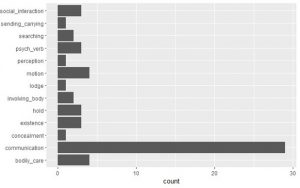
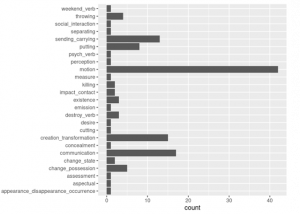
The following graphs show the absolute frequency of narrative imperfect forms (on the horizontal axis) and the verb classes which are used in the narrative imperfect (on the vertical axis) in some Classical, Late-Antique, and Early Byzantine prose texts. As for the verb classes, the classification by Levin 1993 has been used.

The texts that have been chosen are Thucydides’ Histories, Agathias’ Histories and Palladius’ Historia Lausiaca.

Thucydides writes his historiographical work in high-register Attic Greek. Sometimes, he uses rare and poetical words and his Greek is full of long, intricate sentences with many subordinate clauses.

The Historia Lausiaca is a late-antique hagiographical work. It aims to reach a large audience and, as a consequence, it employs a rather simpler Greek. It shows many non-classical features both in the lexicon and in the grammar (such as the use of ἵνα followed by the indicative).

Agathias’ Histories are an early Byzantine high-register text. Agathias’ models are the Classical historiograpical works by Herodotus and Thucydides. He uses rare and poetical words and writes in a classicizing Greek full of rare grammatical features, such as the pluperfect or the future optative. This latter grammatical feature was already rare in the Classical age and was no longer used in the spoken language.


Thucydides’ Histories, book 1, Classical Greek:


Agathias’ Histories, books 1-2, Early Byzantine high-register Greek:


Palladius’ Historia Lausiaca, middle-low-register Early Byzantine Greek:


As the images show, the Early Byzantine high-register Histories of Agathias display a more classical behaviour, especially with verbs of motion, saying and creation. In this text, narrative imperfect forms are more widespread and are used with a wider range of verb classes, in a way that is similar to the classical Thucydides. On the contrary, in the Late-Antique lower-register Historia Lausiaca, the narrative imperfect is commonly employed only with verba dicendi.

It is possible that the extensive use of narrative imperfect forms in classical and Early Post-Classical historiography was felt as a characteristic of the historiographical genre and that it was imitated by late-antique and early Byzantine historians, who wrote in high-register atticizing Greek. It was probably not a (completely) conscious phenomenon, since no one taught people that, when history is the main topic of a literary work, narrative imperfects must be used.

It is possible that the situation was similar to what happens with jokes in Italian. No one explicitly teaches that, when a joke is told, historical present must be used. However, when someone is telling a joke, historical present will probably be the main narrative tense. It is an implicit convention. In a similar way, no one explicitly taught late-antique historians that they had to use narrative imperfects in their historiographical works, and yet high-register historiography is full of narrative imperfects, probably according to an implicit convention.


Bibliography

Allan, R.J. 2017. The Imperfect Unbound: A Cognitive Linguistic Approach to Greek Aspect, in Bentein, K.; Janse, M.; and Soltic, J. (eds.), Variation and Change in Ancient Greek Tense, Aspect and Modality (Leiden; Boston, 2017), 23: 100-130.

Bentein, K. 2016. «Aspectual Choice and the Presentation of Narrative. An Application to Herodotus’ “Histories”», Glotta 92 (1): 24-55.

Comrie, B. 1976. Aspect. An Introduction to the Study of Verbal Aspect and Related Problems. Cambridge: Cambridge University Press.

Fromentin, V. 1998. Denys d’Halicarnasse: Antiquités Romaines, vol. 1. Paris: Les Belles Lettres.

Halliday, M.A.K. 1978. Language as Social Semiotic: The Social Interpretation of Language and Meaning. London: Edward Arnold.

Levin, B. 1993. English Verb Classes and Alternations: A Preliminary Investigation. Chicago and London: The University of Chicago Press.

Mohrmann, C.; Bartelink, G.J.M.; Barchiesi, M. 2001. Palladio. La Storia Lausiaca, 6th ed. Milano: Fondazione Lorenzo Valla.

Moser, A. 2017. Aktionsart, Aspect and Category Change in the History of Greek, in Bentein, K.; Janse, M.; Soltic, J. (eds.), Variation and Change in Ancient Greek Tense, Aspect and Modality (Leiden; Boston: Brill, 2017): 131-157.

How to Thank the Gods: ‘Religious Language’ in Greek Verse Inscriptions?

By Dalia Pratali Maffei

Postdoctoral researcher, Ghent University


The special form and function of religious languages

Have you ever thought that speaking to the supernatural permeates our everyday life? Prayers, words of thanks, and blasphemies are heard and performed across the world every day. These speech acts are part of what we can call ‘religious language’, which can be defined as a language used in a specific context of communication, to talk about or to the supernatural (Darquennes & Vandenbussche 2011: 1).

In many cultures across the world, religious languages tend to be distant from everyday speech, as an indication of a moment that is also perceived as distant from everyday trivial activities. For instance, the ritual language of the Sumbanese in Indonesia is in poetic form and uses metaphors not immediately understood (Mitchell 1988). Dignity and authority are often obtained also through language no longer in use in everyday situations. For instance, we can think of Classical Arabic, used as language of the Quran to this day, while other varieties of Arabic spread in the vernacular; or Latin, used as language of the Catholic Church until 1965, well after Romance languages developed; or the conservative and archaic English grammar and vocabulary (e.g. thou for you, speakest for speak) used for translations of the Bible (Crystal & Davy 1969); or Old Slavonic, still used in Eastern and Orthodox and Catholic Churches (Willi 2003: 11-13). In these last cases mentioned, we should not forget the importance of Church institutions in the preservation and promotion of these varieties (Ferguson 1986). It is also relevant that these religious languages did not happen overnight: their formulaic and conservative character was regularised through time and with usage, and the contrast with vernaculars spoken in everyday situations—which inevitably change—increased with time.


The case of Ancient Greek dedications

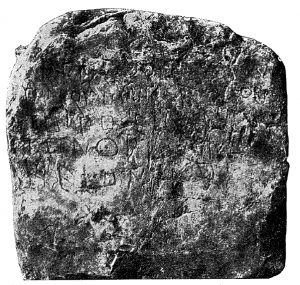
In Ancient Greece in the Hellenistic age (end of 4th – 1st c. BC) we can also observe the development of a language variety used in religious contexts, which was poetic and conservative at the same time, combining the two aspects mentioned above. This language variety can be observed in a specific type of document: inscriptions written on dedications, i.e. objects presented to deities in religious contexts, mainly to ask or to thank for a specific favour, or to gain the mercy of the deity (Guarducci 1967: 121; Licciardello 2022: 13). Usually, these objects were made of durable material such as stone and were altars or statues of gods. A dedication could say something like Αὔτα[νδ]ρο[ςκαὶ] Μῦς̣ τὸν βομὸν ⋮ ℎιε̣ρ[ὸν ἀνέθέ]θεν το͂ι Ποσειδο͂νι τὸν θράνιν ℎελόντε, Autandros and Mys dedicated the sacred altar to Poseidon, after they caught a swordfish (SEG 16-19, Eleusis, 5th c. BC). Here, two fishermen thank the god for an excellent catch: these documents are fascinating because they can offer a unique perspective on the everyday wishes and struggles of Ancient peoples.

SEG 16-19, Picture of the stone, in Guarducci 1967.

What was the language used in these dedications? The first inscriptions we have are from the 8th century BC, and during the Archaic and Classical ages (8th – end of 4th c. BC) some of them attest an interesting combination of elements. First, they were written in poetry, i.e. in verses that followed a specific metrical pattern (mainly hexameters), which provided a certain distance from everyday vernacular, as we saw above. The second interesting element was their dialect: it was a time when Ancient Greek did not consist of one single standard variety, but of many dialects spoken in different areas, each with different grammar features and vocabulary; different dialects were also used in different literary genres, such as Epic, Tragedy, Comedy, etc. So, the peculiarity of these verse dedications is that their dialect was made up of a mixture of forms from the dialect of Homer, i.e. of Epic poems, and of the local dialects spoken where the dedications were set up. So, even if these inscriptions were usually written for everyday and concrete matters, both their poetic form and their unusual dialectal mixture gave them an unusual character (Mickey 1981). At the same time, we cannot really talk about a specific religious language at this time, because metrical inscriptions with this dialectal mixture were also used in different circumstances, e.g. for funerary monuments.

In the following centuries and specifically in the Hellenistic Age (end of 4th – 1st c. BC), local dialects gradually disappeared, replaced by a new variety used across Greece as lingua franca, the Koine. Therefore, we might expect these dialects to disappear also from our verse inscriptions: on the contrary, local dialects kept being used, especially in the case of dedications! Even if, again, it is hard to talk of a specific ‘religious language’, the presence of local dialects in verse dedications more than in other inscriptions was likely due, at least partly, to the fact that religious languages tend to be more conservative. Let us look at this peculiar example from Cyrene, a town in Egyptian Lybia.


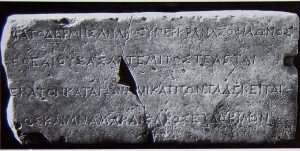
GVCyr 23, Picture of the stone, from the cited edition.

Μνᾶμα τόδ᾿ Ἑρμήσανδρος ὑπὲρ κράνας ὁ Φίλωνος

θῆκε θεᾶι θύσας Ἀρτέμιτος τελετᾶι

βοῦς ἑκατὸν κατάγων καὶ ἴκατι· τῶν τάδε κεῖται

κόσμος καὶ μνάμα καὶ κλέος εὐδόκιμον.

This monument Hermesandros son of Philon dedicated above the fountain (or spring?), once he had sacrificed to the goddess, after leading down (into the sanctuary) for Artemis’ festival hundred and twenty oxes. Of them these (words) remain as ornament and keepsake and glorious fame.


This inscription (GVCyr 23, https://igcyr.unibo.it/gvcyr023) witnesses that a private citizen, probably quite wealthy, dedicated at the sanctuary of Apollon 120 (!!!) oxen, in a public occasion, likely to obtain the favour of the gods as well as the citizens. Most striking is that in the dedication, the poet uses elements of the local dialect (Dobias-Lalou 2020: 207), which was being replaced by the Koine (ᾱ for Koine η in words such as Μνᾶμα; ἴκατι, ‘twenty’, for Koine εἴκοσι; and the god name Ἀρτέμιτος for Ἀρτέμιδος).


An “institutionalised” religious linguistic variety?

While verse dedications seem to hold a conservative dialect across Greece, in Sparta we find one specific sanctuary where dedications showed not just conservative but archaic forms, i.e. forms that had already disappeared—as far as we know—from the dialect, and were used only in that specific context. This was the sanctuary of Artemis Orthia: the archaising dialect of inscriptions was likely favoured by the ancient character of the cult, set up in 700 BC, and by the institutionalisation and continuity of its ritual practices—I mentioned above that often the role of religious institutions was vital to standardise and promote religious languages. It is even more striking to think that the dialect kept being used in the imperial age (1st – 4th c. AD), which implies that religious practices had a role in the preservation of linguistic diversity, as it also happens today. These inscriptions are so peculiar that scholars still debate whether their dialect was artificial, and used exclusively with a religious function, or whether it was still spoken in the rural surroundings (cf. e.g. Alonso Déniz 2014; Kristoffersen 2019). Here is an example of a dedication dated to the 4th – 3rd c. BC (edition in CEG II 821).


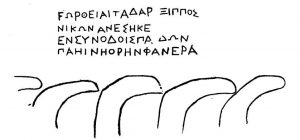
CEG II 821, Facsimile, from Woodword 1907-8. The bottom of the stone shows some carved reliefs.


Ϝωρθείαι τάδ’ Ἀρ[ή]ξιππος νικῶν ἀνέσηκε

ἐν συνόδοις πα[ί]δων πᾶhιν hορῆν φανερά.

Arexippus, the victor, dedicated this to (Artemis) Orthia at the festivals of young boys, visible for all to see.


Here, a victor from local festivals performed at the sanctuary and dedicated a monument to the local goddess, Arthemis Orthia, to thank her for the victory. The dialect of the inscription is local (e.g. ᾱ for Koine η, η for Koine ᾱ in hορῆν), and we find some forms not attested in contemporary prose inscriptions from Sparta, including the name of the goddess herself (Ϝωρθείαι is written with Ϝ, digamma, a letter that indicated the sound /w/; we also have σ for Koine θ in ἀνέσηκε and h for σ in πᾶhιν). This language likely produced a solemn effect, which was also achieved through other elements: the alphabet shows letters no longer in use after the 4th c. BC, such as <Ϝ>, digamma, and <h> to represent an aspirated sound (rather than η). We should assume, anyway, that even if the dialect and the alphabet of these inscriptions was archaic, it was still understood by the devotees and the passers-by. At the same time, we can imagine that it was not always easy to find a balance «between the ordinary and the obscure» (Crystal & Davy 1969), between clear communication and marked language.


Go big or go home

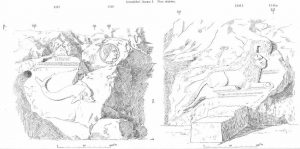
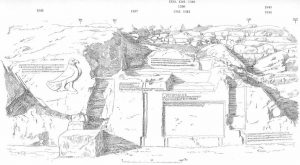
Left side of Artemidoros’ wall, facsimile, from IG XII,3,suppl.

This last example showed how each dedication and context is worth studying on its own: this is especially true in the case of exceptions to the rule, i.e. where we do not find a conservative or archaic language variety. Indeed, we are reminded that «in fixed texts, even the smaller variation might bear social significance» (Ferguson 1986: 210). I am talking about a very peculiar rock. Now we move to the old acropolis of Santorini: at its southern entrance, we find an uneven rock with sixteen verse dedications and several reliefs, all commissioned by the same person, Artemidoros, a Ptolemaic official. This is one of the highest numbers of dedications by the same individual ever recorded in antiquity. They did not simply serve a religious function but were set in a public space and aimed at showing the important role of Artemidoros in the island. Hence, we might not be surprised that they were written not in the local dialect but in Koine (with some poetic dialectal features). Koine was a variety of prestige, to be used in formal situations, and it better represented the political power of Artemidorus, since it was the variety used by the Ptolemaic reign (Pratali Maffei 2023: 207-208).


Right side of Artemidoros’ wall, facsimile, from IG XII,3,suppl.


Beyond verse dedications

These examples showed that verse dedications can teach us much about society in Ancient Greece: not only what people longed for, but also what their relationship with gods was and how they tried to communicate with them. One important lesson we learned is that religious practices contributed to the preservation of language varieties and linguistic diversity and that we have many examples of it in today’s world. Clearly, verse dedications are only a tiny fragment of religious practices: we have dedications in prose, curses on lead tablets, and even the so-called ‘magical papyri’ and confessionary inscriptions from late antiquity. With the emergence of online databases collecting a vast range of documents, such as the EVWRIT database, we have easier access to these documents. This means that their comparative analysis can lead us to a wider, holistic understanding of society and language usages in Ancient Greece, and, in return, can enlighten us on everyday life.


Abbreviations

IG = Inscriptiones Graecae (1873– ).

CEG = Hansen, P.A. (1983–9). Carmina Epigraphica Graeca, 2 vols., Berlin.

SEG = Supplementum epigraphicum Graecum (1923– ).

GVCyr = Dobias-Lalou, C. (2017). Greek Verse Inscriptions of Cyrenaica, in collaboration with A. Bencivenni, with help from J. M. Reynolds and C. Roueché, Bologna, CRR-MM.


Bibliography

Alonso Déniz, A. (2014). ‘L’esprit du temps: koiné, dialecte et hyperdialecte dans les inscriptions agonistiques du sanctuaire d’Artémis Orthia à Sparte’, in S. Minon (éd.), Diffusion de l’Attique et expansion des koinai dans le Péloponnèse et en Grèce centrale, Genève, 141-168.

Crystal, D., & Davy, D. (1969). Investigating English Style. London.

Darquennes, J., & Vandenbussche, W. (2011). ‘Language and Religion as a Sociolinguistic Field of Study. Some Introductory Notes’, Sociolinguistica25(1), 1-11.

Dobias-Lalou, C. (2020). ‘Langue poétique et formes dialectales dans les inscriptions versifiées grecques: le cas de la Cyrénaïque’, Revue de philologie, de littérature et d’histoire anciennes 92(2), 189-212.

Ferguson, C.A. (1986). ‘The Study of Religious Discourse’, in D. Tannen and J. E. Alatis (eds.), Languages and Linguistics. The Interdependence of Theory, Data, and Application, Washington DC, 205-13.

Guarducci, M. (1967–1978). Epigrafia Greca, voll. 1-4, Roma.

Kristoffersen, T.R. (2019). ‘The Artemis Orthia Inscriptions and Spoken Laconian in the Imperial Period. In Defence of Dialect Survival at Sparta’, Glotta 95, 169-189.

Licciardello, F. (2022). Deixis and Frames of Reference in Hellenistic Dedicatory Epigrams, Berlin – Boston.

Mickey, K. (1981). ‘Dialect Consciousness and Literary Language. An Example from Ancient Greek’, TPhS 79(1), 35-66.

Mitchell, D. (1988). ‘Method in the Metaphor. The Ritual Language of Wanukaka’, in J. J. Fox (ed.), To Speak in Pairs, Essays on the Ritual Languages of Eastern Indonesia, Cambridge, 64-86.

Pratali Maffei, D. (2023). The Dialect of Hellenistic Inscribed Epigrams from Doric-Speaking Areas, PhD Thesis, University of Cambridge.

Sawyer, J.F., Simpson, J.M.Y., & Asher, R.E. (2001). Concise Encyclopedia of Language and Religion, Elsevier.

Willi, A. (2003). The languages of Aristophanes. Aspects of Linguistic Variation in Classical Attic Greek, Oxford.

The things I might tell you of Umm Abū l-Qāsim: the function of gossip in an Arabic letter on papyrus

By Fokelien Kootstra

Postdoctoral researcher, Ghent University

Nobody likes a gossip, yet everyone has encountered gossip in their life, and likely even participated in it. Our intuitive familiarity with the genre makes the following passage from an Arabic letter written in Egypt, in the 10th/11th century AD (P.Berl.Arab II 81) immediately recognizable as gossip to the modern reader:

Send greetings […] to the lady, and tell her […] my lady, did you forget the housekeeper? And tell the lady: my lady, the things I might tell you of Umm Abū l-Qāsim. She said bad things about you, and she was disapproving of you, because a woman – who you know – news from her ceased to arrive. And news from you and your inquiries after her also ceased to arrive. And you know, my lady, that such talk is gossipy. When I talk to her, I would say: don’t you know how such talk goes? Is betrayal your goal? Who are you?! I know, an enemy! Since the day that she complained I have only seen her twice.

The gossip section takes up about half of the space of the letter. The letter starts out with a proclamation of how much she misses the addressee, followed by a short question about how the addressee is doing in the first nine lines. Following some greetings to several other people, we find the gossip passage above, which takes up the next twelve lines, then the letter seems to end with another list of greetings to more people and presumably, although the lines are damaged to the point of being unreadable, final greetings to the addressee to close the text.

Why would the sender of the letter spend so much of her writing on this piece of gossip, and one that was not even addressed to the person she ostensibly wants to share the gossip with?

The social function of gossip

We generally consider gossip as something negative. Gossip is seen as mean and divisive, and people who gossip will often distance themselves from it by describing what they are doing as ‘small talk’, ‘chitchat’, or even ‘nothing,’ when directly asked what they were talking about (Foster 2004, 88). Much of the research on gossip, however, uses a slightly broader definition, which includes not only talk expressing negative value judgements of a person who is not there, but also positive discussions of others. This widens the category of gossip to include social talk more generally.

When thus defined, researchers have recognized four main social functions of gossip: the gathering and exchange of social information, a form of entertainment, a way to informally communicate and enforce social norms within a group, which helps to create and strengthen group solidarity and potentially a sense of belonging (already outlined by Stirling 1956). Although the exact numbers differ, it has been shown that people spend a considerable proportion of their social interactions engaged in exchanging information about others or even outright gossiping (for example, Dunbar, Marriott, and Duncan 1997; Emler 1990; Slade 1997).

What is the sender trying to say?

The strong denouncement of the behavior of Umm Abū l-Qāsim by our sender clearly shows that gossip was judged negatively in tenth-century Egypt as well. She goes as far as to call Umm Abū l-Qāsim an ‘enemy’ of the addressee and accuses her of ‘betrayal’, on account of her gossiping. By doing so, she is clearly distancing herself from such unacceptable social behavior, and seemingly, even from the gossip herself. At the same time, she differentiates what she is doing from gossiping, she is just warning her friend. If she was merely concerned for her friend’s reputation, however, telling off Umm Abū l-Qāsim for her behavior would, surely, have sufficed. What is she really trying to tell her friend? To get a better grip on this, let’s have a look at what accusation is being made against the addressee.

Apparently, Umm Abū l-Qāsim has been going around saying that the lady in question stopped sending letters and inquiring after her well-being. From the sender’s reaction we gather that this was considered a terrible accusation. The contemporary equivalent of ghosting someone could lead to a bad reputation, or so the sender would have us believe. In this sense, the piece of gossip becomes a warning: Do not neglect me as you have neglected Umm Abū l-Qāsim, or people will say bad things about you. Read as a warning, it helps to make sense of the question the sender posed at the beginning of her address to the lady in question: ‘did you forget your housekeeper?’ It seems the sender was referring to herself and had not heard from her mistress in a while.

Gossip in context: The ‘you never write to me’ trope

Reading this section of the letter as a threat not to ignore the sender, connects this piece of gossip to a common topic in personal letters from this period. Besides the inclusion of greetings to the addressee and people around them, Arabic, as well as Greek letters, often contain requests to write back soon, in combination with expressions of longing and complaints of not having heard from the addressee in response to previous letters. This sender seems to have found a rather creative way of encouraging the addressee to write to her, but was expressing a very common, and likely instantly recognizable, complaint. Couching it in a piece of gossip about someone else, allowed her to voice her complaint indirectly to her employer, who clearly had social and economic power over the sender. It even allowed her to cast herself as virtuously protecting the reputation of her mistress.

Gossip in context: privacy and letter writing

As to why the sender would put such a message inside a letter that was ostensibly written to someone else, this may also have had something to do with the power imbalance between the sender and the addressee. Having a friend relay the message to her mistress for her might have been more socially acceptable than sending her mistress a letter directly. There are several examples in the Arabic papyri of letters in which senders petition people to intercede with more powerful individuals on their behalf.  However, as Klaas Bentein’s blog post on ‘getting involved’ already pointed out, it was common for letters to contain greetings and messages to multiple people in the Greek context, and it is commonly assumed that letters were read out with the interested members of the household present. In the Arabic speaking context in the period that this letter was written, similar habits of communication involving letters were still common, so the reason may also have been one of convenience. Travel was not always easy, so combining messages to people who lived near each other saved time and effort.

It is passages like this in these historical letters, which feel immediately intimate and relatable, that remind us that even though the frameworks in which we operate and the formulae we use to express ourselves may have changed, some aspects of our social exchanges have remained remarkably similar.

References

Diem, W. 1997. Arabische Briefe Des 7. Bis 13. Jahrhunderts Aus Den Staatlichen Museen Berlin. Vol. 2 Arabische Urkunden. 2 vols. Documenta Arabica Antiqua, 4 Ägyptische Urkunden aus den Staatlichen Museen Berlin. Wiesbaden: Harrassowitz.

Dunbar, R.I.M., A. Marriott, and N.D.C. Duncan. 1997. “Human Conversational Behavior.” Human Nature 8: 231–46.

Emler, N. 1990. “A Social Psychology of Reputation.” European Review of Social Psychology 1: 171–93.

Foster, Eric, K. 2004. “Research on Gossip: Taxonomy, Methods, and Future Directions.” Review of General Psychology 8 (2): 78–99.

Slade, D. 1997. “Stories and Gossip in English: The Macro-Structure of Casual Talk.” Prospect 12: 43–71.

Stirling, R.B. 1956. “Some Psychological Mechanisms Operative in Gossip.” Social Forces 34: 262–67.

Accounts of building activities, through the perspective of a modern parallel case

By Kyriaki Giannikou

Research assistant@EVWRIT


Among all types of documentary texts written and preserved on papyrus, accounts have undoubtedly received the least attention, perceived as “unremarkable” economic texts (Jones in Bagnall (ed.) 2009, 370). Although taken into account when in need of compiling economic data (eg. wages, prices of goods etc.) to facilitate, among others, the approximate placement in time of undated papyri (eg. Johnson and West 1949), the analysis of those “mere lists of income and expenses” (Jones in Bagnall (ed.) 2009, 370) often ends there.

Undoubtedly, the absence of a high degree of standardization in terms of both form and content combined with the hyper-concise and usually fragmentary nature of the preserved text deter scholarship from a comprehensive study on accounts. However, hereby, I will attempt to highlight some characteristics of accounts and, more specifically, entries concerning builders and building practices. I intend to do so by presenting a modern account of this type and its characteristics, tracing them back to either similar or conflicting characteristics of ancient, parallel documents. What this modern source could bring to the discussion is debatable but possibly useful, as I was able to collect different testimonies of the contractor’s family environment, which provided an extra layer of meaning and posed questions to the ancient sources.

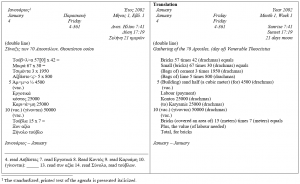
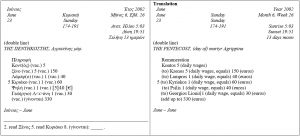
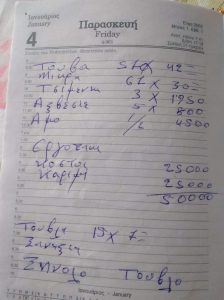
Our modern source of the recent past dates back to 2002 and originates from a village in Chios, Greece. It’s part of a standard, lined-paper agenda used by Ioannis M. Kontos, an expert builder and contractor, to keep track of his work-related finances. For the purpose of this post, I adduce the following two entries:


  • Entry of January 4th 

  • Entry of June 23rd (translation on the right)

First glance: handwriting and layout

Building Account: cost of materials, wages, final cost (Nea Potamia, Chios, Greece, January 4th 2002)
Beginning with our modern source, the handwriting is definitely not immaculate, but it remains legible. It is not cursive and ligatures are almost entirely absent. Overall, it constitutes a quite slow hand, the flow of which seems difficult to maintain.

With regards to the page layout, neither the line division itself is respected (eg. l.4 αξβέστε<ς>: written over the line) nor the writing is always parallel to the lining (eg. l.2 μικρά: flowing between two lines). This is also the case for the hourly division; it is not taken into consideration, as there is no need of such details. However, the entries were written or at least refer to the date indicated on the top of the page, proven by notes of the same agenda on preparations for the village’s annual festivity.


P.Ryl. IV 642 = TM 32768, verso (Fr1) (Building Account, Hermopolis, early 4th CE)
Similarly, this ancient specimen of the same document type is far from polished in terms of appearance. Although the handwriting seems to reveal a person who writes regularly and probably professionally, it is the speed of writing which increases the amount of ligatures and reduces legibility; in extreme cases (eg. l.12 Ἀμμωνίου) words are written as ribbon-like lines and individual letters are hardly distinguishable.

Concerning the layout, the account is chronologically organized by the specification of the date each entry corresponds to, at the beginning of a line (eg. l.8 ιδ, l.9 ις etc.). All entries probably refer to the month of Mesorē, stated once on the recto (l.8) of the document. Appearance-wise, it’s messy; the interlinear space is by no means consistent (eg. ll. 13-15-15 compared to 10-11) and the lines of writing are not always parallel to each other.

Both fast-penned, highly cursive and slow, awkward handwriting, along with a clumsy handling of the page layout, reveal the same thing; in both cases, practicality is prioritized over neat appearance, and that’s highly expected when dealing with private (building or not) accounts. These notes were intended for personal use (in the case of the modern parallel) or at least use by a very specific set of people, for example a steward who penned it and the builder who is familiar with the content and can easily access it through messy notes. In the case of the modern text though, there is an extra layer, competence; it was a barely schooled builder who wrote the notes down, while the fluent hand of the ancient text allows the assumption of a quite well-trained hand.

This focus on practicality is particularly accentuated when comparing the documents above to the following estimate of a building project.


P.Oxy. XII 1450 = TM 21851 (Estimate of Repairing a Public Building, Oxyrhynchos, 249-250)

(translation: https://archive.org/details/oxyrhynchuspapyr12gren/page/144/mode/2up)

In this case, estimates on the cost of repairing a public building are submitted to the local authority, probably for approval. Although the content is close to what we would expect from a building account, here it takes the form of an official document.

This is clearly pictured in the way the document was written; the handwriting is neat, formal and, thus, highly legible. The individual letters are fast but still carefully penned and frequently ligatured.

In terms of layout, the text is beautifully penned on the page; the interlinear space remains consistent, while the lines form a block of text, retaining a clear margin on the right side. The date the document was drawn up is also written at the bottom part of the page, clearly separated from the main body of the text.

All three documents deal with the cost of building and wages, but the function, and thus the appearance, of the third one is different; the focus shifts from practicality to formality and the reader to whom it’s addressed shifts from a building expert to a local authority.


Content: note-taking method

The accounts’ focus on practicality and efficiency also extends to their content.

P.Ryl. IV 642 = TM 32768, verso (Fr1) (Building Account, Hermopolis, early 4th CE)

In this representative example of an ancient building account, the entries take the form of elliptical constructions. The text is concise; all important details are given and the elided elements (mostly verbs) are easily recoverable, while the text remains far from verbose. Space and time (both when writing and reading) efficiency, is also achieved by extensive use of abbreviations. Frequently used terms related to money (eg. ἀργύριον, δραχμαὶ) or the building profession (eg. οἰκοδόμος, ἐργάτης), along with common prepositions and adverbs used in accounts, are abbreviated due to being familiar, recurring and highly expected in that context, along with easily predictable endings of the names mentioned (eg. l.16 Χώλ(ου)).

The text does not present mistakes in terms of orthography, which could be due to the fact that most of the text is being abbreviated and pretty standard.


Building Account: cost of materials, wages, final cost (Nea Potamia, Chios, Greece, January 4th 2002)

In our modern parallel text, the information is written down in the form of a brief list; even more elliptical note-taking than above. The content remains pretty clear, except perhaps in ll.12-14; still, it must have been clear for its writer, fulfilling its purpose as a note.

In this case, the orthography is way more problematic. Accentuation is totally omitted, along with several letters, while others are mixed up. The confusion of σ and ξ is very frequent. In l.4 (Αξβέστε<ς>), it can be justified taking into consideration the pronunciation and the paleographic closeness of ζ and ξ. Factors like the local dialect or lack of knowledge might account for the rest.

Once again, when formality is added to the equation due to the change of the receiver of the information, the differences are evident, also in terms of content.


P.Oxy. XII 1450 = TM 21851 (Estimate of Repairing a Public Building, Oxyrhynchos, 249-250)

(translation: https://archive.org/details/oxyrhynchuspapyr12gren/page/144/mode/2up)

The aforementioned official document providing estimates for a building repair is descriptive and detailed, in contrast to the accounts. Even the abbreviations are kept to a bare minimum, retaining only those indicating the measuring unit (l.1 ἐμβαδικ(ῶν) πηχ(ῶν)) and the symbols indicating the currency (eg. l.6 (δραχμῶν), (ὀβολοῦ), (πεντώβολον)), along with (perhaps) the terms “more or less” (l.9 πλ(εῖον) ἢ ἔλατ(τον)) that are also regularly repeated unabbreviated.

In terms of orthography, we wouldn’t say it’s very problematic, but mistakes are not absent; all of them can be explained taking iotacism into consideration.


Practice beyond the documents: labour remuneration

Building Account: labour remuneration (Nea Potamia, Chios, Greece, June 23rd 2002)

The entry of June 23rd refers to calculations on the remuneration (πληρωμή) of the construction team, the contractor himself included. He worked for 5 days, his wage not given, as it was probably negotiable and changed according to the agreement and the total remuneration he received for each project. His main, “permanently” employed worker and assistant (Ξένος) also worked for 5 days. Meanwhile, during the week, different other workers and experts also worked for him, receiving one daily wage each, ranging from 30 to 60 euros.

Dealing with this modern source, I was able to access background information on the payment of workers by the contractor through testimonies, which made it possible to explain the difference in the workers’ remuneration. The main worker (Ξένος) received 30 euros as a daily wage; he was an unskilled worker who mainly assisted the contractor in a range of different tasks. The same holds true for the lastly listed and equally paid worker (Γεώ(ργιος) Λ<ι>ονής). Note that the “permanent” employment of the former is an additional feature that makes a lower daily wage expected. The rest of the workers seem to have some kind of expertise, hence their higher wage; Lampros’ (l.4) expertise could not be recalled by the contractor’s family environment, but it seems that Kyriakos (l.5) was an expert builder (daily wage of 60 euros), while Psilis’ (l.6) specialty was formwork (daily wage of 50 euros).

Taking into consideration both that this entry and notes on payment are written on a Sunday and that the payment refers to a maximum of 5 days of labour, it stands to reason to assume that the contractor used to pay his workers every end of the week. Indeed, testimonies helped to confirm that.

Lastly, I focused on the type of labour remuneration, which in this case is clearly monetary. However, testimonies revealed that offering of goods was also a common practice for the contractor, but not as a labour remuneration; as an act of appreciation and community bonding, on top and beyond any employer-employee relations.


Labour remuneration in Roman and Byzantine Egypt

Concerning workers’ wages, ancient sources vary significantly. Freu (JRA 28, 161-177) refers to “the milieux of employment, availability of the manpower, forms of employment, and social statuses of partners” as substantial criteria for differentiation in wages (p.162).

As in modern times, there was a wage difference between unskilled and skilled workers which, though, seems to have been sharper. Casual, unskilled workers received a wage two to four times lower than building experts (p.167).

Similarly, the duration of the employment could influence labour remuneration, but it is not entirely clear how (p.177). Aside from that, we observe an important difference. The duration of employment seems to have directly influenced the type of remuneration as well. More “permanent” employees normally received a small amount of cash per month (ὀψώνιον) along with food or other types of indirect payment, while casual workers mainly received their daily wage (μισθός) in cash, without any addition of food being systematically indicated (p.163).

Lastly, in contrast to our modern source, where we often find entries listing the same people receiving the same daily wage, ancient sources depict a daily wage that could possibly fluctuate day by day (p.163).


To conclude

I would like to conclude by pointing out that even such seemingly uninformative and not interesting documents like (building) accounts can give us more information on the way people engaged in efficient note-taking, organized and executed their professional responsibilities, and, comparing them to a modern source, the way they did so is not as far from our reality as we might think.

What would be even more interesting for further research is the comparison of wages and cost of basic goods, to be able to draw some indicative conclusions on how the purchasing power of a construction worker evolved through the ages or even the effect of reformations on those (eg. the Edict of Diocletian or the Reform of Constantine compared to the transition of Greece from the drachma to euro in 2002). However, it is true that a plethora of fragments of accounts remain unpublished, and that leaves the fruitfulness of such attempts questionable. Nonetheless, accounts spark scholars’ interest (see the recent volume by Jördens and Yiftach (eds., 2020) on “Accounts and Bookkeeping in the Ancient World”), which is promising for stimulating further research on the topic.

Writing wishes. Back to the future with the papyri

By Ezra la Roi

Affiliated PhD Researcher@EVWRIT

Emails, cards and letters

We might not realize, but we consciously adapted our communication practices to the pandemic. When you write an email to someone during the pandemic, whether it is a close contact or not, it is normal (socially speaking) that the email starts with the wish that it finds them in good health (read between the lines: given the pandemic). In 2020 or 2021, when matters were much worse, such formulations were conventionally more elaborate such as I hope that you nor your loved ones are hit hard by the pandemic or I hope you’re very well and I’m sending you and your family my best wishes. Such wishes are of course not entirely new, as wishing someone well is common practice in letters or cards to friends and family. In fact, in our daily life we use wishes quite frequently and for a great variety of reasons, e.g. Happy birthday! Merry Christmas! Have fun! Good luck! Bless you! or I wish I could. Given the important social function of such wishes, we may therefore hypothesize (with the so-called uniformitarian hypothesis or principle) that the Greek papyri from Egypt could show similar wish structures to fulfill these social functions (cf. Vandorpe on indexing dimensions of happiness in Hellenistic Egypt).

At first glance, we find wishes in the papyri that are remarkably similar to those that we tend to use. Take for example the frequent use of health wishes that we find in the papyri, for example with the so-called wish optative εἴη μὲν ὑγίεια “may there be health”, ἐρρῶσθαι ὑμᾶς εἴη “may it be that you are well” or εἴη μέν μοι ὑγιαίνοντα X “I wish that X is well” or its countless variations, e.g. the performative “I wish that you are well” ἐρρῶσθαί σε/σε ὑγιαίνειν εὔχομαι or descriptive alternatives καλῶς ἂν ἔχοι εἰ ἔρρωσαι or εἰ ἔρρωσαι, εὖ ἂν ἔχοι “it would be good if you are well”. However, when you dig deeper, you inevitably find that there is much more to say about wishes in the papyri, not only about how they are used but also where they are used. Wishes are, for example, not confined to letters but occur in many other text types that we can distinguish in the papyri, such as petitions, wills, contracts, oaths or declarations. Their wide distribution underlines the importance ascribed to them by those who entrusted their communication to papyri. What was it about wishes then that made the use of wishes so popular and ostensibly still does?

When to wish and why

In general, wishes were used in many different communicative contexts. A first indication of where and why wishes are used in the papyri can be glanced from which wishes are most frequent. The most frequent wish usage with the wish optative is for example to substantiate a form of declaration or oath. In the following declaration Epimachus declares that he did not collect tax or will be in a position to do so:

I swear by Nero Claudius Caesar Augustus Germanicus Imperator that I have levied no contributions for any purpose whatever in the said village and that henceforward I shall not become headman of a village; otherwise let me be liable to the consequences of the oath. [ἢ ἔνοχος εἴην τῷ ὅρκ(ῳ)] (p.oxy.2.239=TM 20508, https://papyri.info/apis/upenn.apis.12)

Performative wish expressions also occur very frequently and especially to either wish the addressee well (at both the start and the end of letters, e.g. P.Oslo 2 60= TM 28905, https://papyri.info/ddbdp/p.oslo;2;60) or to signal a person’s wish to lease:

I wish to lease from you [βούλομαι μισθώσασθαι παρὰ σοῦ] the retailing of perfumes and spices, desiring a fourth part of the half share allotted to you in the division of Themistes, exclusive of markets and festivals, for the present second year only at a total rent of forty-five drachmae of silver, which I will pay monthly in equal instalments if you agree to give the lease. (P.Fay. 93=TM 10936, https://papyri.info/ddbdp/p.fay;;93)

Less often one finds a wish optative as a greeting such as Χαίροις Ἥρων. “Greetings, Heron.” (sb.14.12176=TM 27526, https://papyri.info/ddbdp/sb;14;12176). This specific usage of the wish optative is actually an innovation of papyri from the Roman period, as these greetings were before just expressed by the bare imperative χαίρε or the independent (so-called insubordinate) use of the infinitive χαίρειν. Another more infrequent pattern is when the wish occurs mid-sentence (i.e. parenthetically) to qualify an undesirable outcome of a contractual agreement:

and if—which heaven forbid [ὃ [μὴ ε]ἴ̣η]—a separation takes place, I will restore it as stated above, and in answer to the formal question I have given my consent. (P.Oxy. 10 1273 = TM 21791, https://papyri.info/ddbdp/p.oxy;10;1273)

Wishes thus can mitigate the communicative message as well as perform socially desirable actions in a wide range of text types from the papyri.

If only I could

Another sign that wishes serve important social functions is that they can reveal communicative norms. In the following private letter Epagathos assures his sister that he is doing what is expected of him, to keep her as informed as possible. He conveys this message more indirectly though. By means of the counterfactual wish that he wished but could not send her more, he indirectly signals that his effort to keep the communication going may be expected socially. In other words, this counterfactual wish reveals a communicative norm which resembles the Gricean maxim of quantity of communication in general: be as informative as possible and necessary. After all, he is asking her to display the same socially expected behaviour (δήλωσόν μοι περὶ ὧν ἔπεμψά σοι).

δήλωσόν μοι περὶ ὧν ἔπεμψά σοι. ἤθελον καὶ πέμψε(<πέμψαι) σοί τι ἄλλο, καὶ οὐδεὶς λαμβάνε[ι] ὅ̣[πω]ς σοι κομισθῇ.(BGU 2 384=TM 28132, https://papyri.info/ddbdp/bgu;2;384)
Inform me about that which I have sent you. I would have wanted to send you something else as well, but nobody is taking it with them to bring to you.

Similarly, counterfactual wishes can be used to indicate someone’s commitment, for example to a loved one far away.

ὤφελον εἰ ἐδυ̣νάμε̣θα πετᾶ̣σ̣θαι καὶ ἐλ̣θεῖν καὶ προσκυνῆσαί σε (P. Giss. 1 17, 10-12=TM 19419, https://papyri.info/ddbdp/p.giss.apoll;;13 )
Would that we were able to fly and come and embrace you

Putting the pieces of the puzzle together

Even though important, wishes are of course just one of the ingredients of the communicative behavior that we find in the papyri. One of the main strengths of the EVWRIT project is that it seeks to go beyond the linguistic ingredients that produce the social cocktail of communication; matters of formatting, handwriting, orthography or vocabulary could all have significant but yet not well understood social potential. With the expected arrival of the EVWRIT database, we will be able to grasp the social correlations between the medium (in all its dimensions) and the message of papyrological texts. Looking back at wishes and how they reveal sudden changes in communication practice, I think that we could stress yet another important dimension, the diachronic one. As briefly mentioned above, wish structures became more widespread and versatile in the papyrological evidence. It therefore stands to reason that they could show evidence of social change as well, for example when wishes focus less on cursing or start evoking different deities in Post-Classical papyri than wishes in Classical Greek texts do. Also, due to the prominence of these health wishes, choosing to vary your health wish became socially significant in Post-Classical Greek texts (cf. Nachtergaele), much like the health wishes in the pandemic. Such social time travel also reveals significant differences with the present. For example, each involved person signing a collective letter/postcard was not standard in the papyri (cf. Bentein). Nowadays, however, we all have to sign birthday cards to show our involvement. Or think of the curious Dutch custom to congratulate those close to the birthday person with that person’s birthday. Thus, the paradoxical lesson that we could learn from the papyri, much like the movie Back to the future, would be that time travel to the past helps us understand the present just as travelling back to the present will help us understand the past.

The Study of the Septuagint, Its Language, and the Importance of Hellenistic Papyri

By Marieke Dhont

Post-doctoral researcher@EVWRIT

The Septuagint, the Greek translation of the Jewish scriptures born out of the encounter of the ancient Mediterranean East with the Hellenistic expansion of the Greek world, represents the oldest substantial corpus of translated texts at our disposal. The corpus was produced book per book by translators unknown to us, sometime between the late third century BCE and the first century CE, in Egypt and/or Palestine, and became the Bible for Greek-speaking Jews and early Christians.

The Early Days of Septuagint Research: The Septuagint as a Textual Witness
In the last thirty or so years, scholarship has increasingly approached the Septuagint as the literary and socio-cultural artefact of a community of Hellenophone Jews. Until the late twentieth century, however, the main focus of Septuagint research was its use as a textual witness to a Hebrew source text that is now lost to us.


Image from the Codex Sinaiticus, dated to the fourth century CE, containing Deut 3:8-4:1, available via https://codexsinaiticus.org

The Septuagint, the oldest complete manuscripts for which date back to the third and fourth century CE, was mined for textual variants in relation to the significantly younger, medieval Masoretic Text, the oldest text of the Hebrew Bible at our disposal until the discovery of the fragmentary Dead Sea Scrolls. For each variant, it was then established whether the cause for the variant would lie with the translator, either as the result of a presumed mistake or of their translation methods, or if the variant reading in question reflected an underlying Hebrew text that differs from the Masoretic Text.

For example, in Exod 1:5, the Masoretic Text states that the number of Jacob’s descendants travelling to Egypt was seventy, while the Septuagint mentions there were seventy-five.

For long, the Septuagint was often thought to be inferior to the Masoretic Text. The discovery of the Dead Sea Scrolls (dated approximately to the third century BCE to the first century CE), however, showed us that at times the Septuagint would indeed agree with the Scrolls against the Masoretic Text.
When the Scrolls were found, it became clear that the translator of Exodus probably had a Hebrew source text reflecting that same reading of seventy-five: a fragment referred to as 4QExoda, which contains Exod 1:3-17, also mentions the number “five” here.

The Septuagint and Textual Plurality
The Dead Sea Scrolls also showed us that in the Hellenistic period different versions of the same scriptural book circulated alongside one another – a phenomenon often referred to as “textual plurality”. Prior to the establishment of the Masoretic text, the textual world of ancient Judaism and its scriptural traditions was rich and varied – and the Septuagint is part of that richness, of the textual plurality of ancient Judaism.

The Septuagint as a Cultural Product of Hellenistic Judaism
The Septuagint is the first attested step in a centuries-long tradition of scriptural translation, but how do we understand the Septuagint as a cultural product, meaning as Greek text within a Jewish context and as a textual product within the Greek-speaking world? In this respect, the language of the Septuagint has been an important area of research.

For example, on the translators’ part, adherence to the form of the Hebrew would sometimes override the desire to use of Greek idiom. By way of illustration, we may look at the expression of greetings. In Hebrew, the idiom “to greet someone” consists of a verb שׁאל, ša’al, “to ask” and the noun שׁלום, šalom, “peace” introduced by a prepositional lamed. The person who is greeted is introduced also by a prepositional lamed. Taking the expression piece by piece in English, we get something like “to inquire for someone’s peace.” The Septuagint rendering of this idiom varies. In 1Sam 10:4, we find καὶ ἐρωτήσουσίν σε τὰ εἰς εἰρήνην “and they will ask you about matters regarding peace.” The translator has rendered the elements of the Hebrew idiom individually into Greek with word-by-word equivalents. The result is a Greek construction that reflects the Hebrew source text in a way that is not idiomatic in Greek. In such a case, scholarship speaks of interference. Alternatively, when a translator aims to express the meaning of the Hebrew in Greek idiom, we encounter renderings such as ἠρώτησεν δὲ αὐτούς Πῶς ἔχετε; “they asked them, ‘How do you do?’” in Gen 43:27 or καὶ ἠσπάσαντο αὐτόν “and they greeted him” in Judg 18:15. The meaning of the Hebrew and the Greek essentially remains the same, but the translators of the various books display different attitudes as to what they considered the most appropriate rendering in Greek.

Interference versus Idiom
The degree of Hebrew interference versus Greek idiom, however, is a long-standing topic of debate in Septuagint scholarship. The language of the Septuagint is, admittedly, different from that of Greek literary works – but how do we understand this difference? Scholars who emphasized the extent of interference from the Hebrew in the Septuagint understood the Greek as stylistically poor or odd and often posited that Hellenophone Jews either used a specific Judeo-Greek dialect or were poorly educated in Greek. However, in the twentieth and twenty-first centuries, the field of Classics has seen an increase in interest in the Hellenistic period and its written output, including inscriptions as well as sub-literary and documentary papyri. The increase in available papyri and inscriptions, as well as the increasing access to and searchability of this material through databases, has given a significant boost to Septuagint scholarship and has highly increased our understanding of the language of the Septuagint.

For example, the Greek Psalter contains many different epithets for God. The translator sometimes deviates from the Hebrew text. In Ps (LXX) 90:2, for example, we read ἀντιλήμπτωρ μου εἶ καὶ καταφυγή μου, “You are my defender and my refuge”, where the Hebrew reads “my refuge and my fortress.” While ἀντιλήμπτωρ was long considered a specifically “biblical” word, Hellenistic papyri show that the term was used for the Ptolemaic king or other officials in the context of requests, often to resolve legal disputes. See, for example, lines 19-20 in BGU IV 1139 = TM 18583 (first century BCE, https://papyri.info/¬ddbdp/bgu;4;1139):

ἀξιῶ σε̣ τὸν πάντ(ων) σωτῆ(ρα) καὶ ἀντιλ(ήμπτορα) ἐά[ν σ]οι φαίνη(ται) σ̣υ̣ν̣τάξαι…
Therefore we ask that you, the saviour and defender of all, if it seems good, order…

The occurrence of the same word in the Septuagint and contemporary papyri explains not only the translator’s choice of words, but also why the translator deviates from the Hebrew: they use terms specific of the cultural context that would resonate with their audience.

The papyri have shown that the language of the Septuagint essentially reflects post-classical Greek. By extension, contextualizing the language of the Septuagint helps us to contextualize ancient Jews as insiders within the Greek-speaking world, rather than as outsiders. The question of language now is one, not of the translators’ ability in Greek, which has been carefully established, but of register and variation in post-classical Greek.

EVWRIT and the Septuagint

As we move away from understanding the Septuagint primarily in relation to the Hebrew, we can move towards understanding the Septuagint within the history of Greek. Research into the language of the Septuagint thus far has primarily focused on analyzing the vocabulary of the Septuagint; less attention has been paid to the syntax of the Septuagint in relation to papyri. It is in this regard in particular that the EVWRIT project and its database will offer a wealth of new material for those studying the Septuagint. The EVWRIT database provides a tool for and opens up new avenues to studying the syntax of the Septuagint and the questions of interference and contact-induced linguistic change.

Female Voices in Greek Papyrus Letters. Women Letter-Writers and Their Male Correspondents

by Marianna Thoma

Associated researcher@EVWRIT

Across the centuries, women’s letters offer us direct contact with their thoughts and feelings and illuminate the roles women played within their families, their communities, and the social and political movements of their times. Over time, a large number of women’s correspondences have been made the subject of various publications. For example, women letter writers in early modern Europe created lengthy correspondences, where they expressed their literacy and their creativity (cf. J. M. Ferrante. 1997. To the Glory of Her Sex: Women’s Roles in the Composition oMedieval Texts. Bloomington). Recently I published a monograph in Modern Greek language entitled “Women letter-writers in ancient Greek papyri” (Γυναίκες Επιστολογράφοι στους Αρχαίους Ελληνικούς Παπύρους) which includes an updated list of women’s papyrus letters from the Hellenistic to the Byzantine times with their translation and commentary and could be considered as a supplement to the monograph offered by R. Bagnall and R. Cribiore fifteen years ago (“Women’s Letters from Ancient Egypt, 300 BC-AD 800”, 2006/ 2008 online version).

While studying these letters, I was excited by the immediacy and sense of direct access to the personal lives of people who lived two millennia ago. What is more, women are definitely expressing themselves on their own behalf and not through a male who controls the representation of their thought, contrary to ancient literary texts, in most of which we learn about women through their male authors. Although in many cases, it turns out to be remarkably difficult to be sure who wrote the letters discussed, since a great percentage of women in antiquity were illiterate, we can recognize in these letters the female way of thinking which seems to be common to women of all times.

Women’s papyrus letters provide us with rich information about their everyday experiences, emotions and social attitudes. They give evidence of the women’s active participation in various aspects of everyday life, such as the management of household businesses and legal matters. Their letters also demonstrate women’s everyday influence on their male recipients.


Woman with wax tablets and stylus (so-called “Sappho”)


 Household Management

Women letter-writers have a prominent role in family letters exchanged between members of the household who are separated by geographical distance due to various reasons (work, education, marriage etc.). Several wives appear to reassure their husbands about their successful household management in their absence. A characteristic example from 99 A.D. is the detailed report sent by Apollonous to her brother/husband Terentianus in regard with various economic and family issues (P.Mich. VIII 464 = TM17238, https://papyri.info/ddbdp/p.mich;8;464). During his absence, the writer appears to manage the household affairs quite successfully. She conveys him a lot of information and positive news with regard to the productivity of their fields and their children’s education:

And do not worry about the children; they are in good health, and they are kept busy with a teacher. And about your fields, I have reduced your brother’s rent to the extent of two artabai. Now I receive from him eight artabai of wheat and six artabai of vegetable seed. And do not worry about us and take care of yourself. I understood from Thermouthas that you obtained for yourself a pair of belts, and I was much gratified. And about the olive yards, they are quite productive so far. And the gods willing, if it is possible, come to us.”

Women’s Self-Representation as the “Weak Sex”: Social Reality or Rhetorical Strategy?

Papyrus letters show that women, and mainly wives addressing to their husbands, very frequently give advice, directions or orders on economic and business matters. It is interesting that even when female authors admit their sex weakness in their letters, they appear to be powerful enough to affect men’s decisions. An illustrative example is offered by the letter of a dynamic wife to her husband, in which she sends various types of advice and instructions although behaving with modesty (P.Giss. I 79 = TM 19468, 117-118 A.D):

But if God allows a large yield next season, soon, because of what will be the low price of the produce, the landowners will be discouraged, so that we will be able to buy at a low price, as you wish.”  (tr. Bagnall – Cribiore 2006, 162).

The writer even advises her husband to wait for the next season before he buys land. Although she tries to influence her husband, she highlights her weakness due to her sex, aiming at a captatio benevolentiae in order to gain her husband’s attention and comprehension.

“… I could take hold of the management of our property, I would not hesitate, but in any case, as I am a woman, I exercise every care”. (tr. Bagnall – Cribiore 2006, 162).

Applying Emotional Pressure

Besides her advice, a wife can also apply emotional pressure on her husband so that she ensures his help and support. A threat full of disappointment and anxiety is expressed in a letter from the second or third century Oxyrhynchos, written by a certain Isidora to her husband Hermias. The writer is afraid that her sick child is about to die and asks her husband to return home immediately to assist her (PSI III 177 = TM 28065, https://papyri.info/ddbdp/psi;3;177).

The child is sick. He has lost weight, since he has not eaten for six days. I am afraid that he is going to die in your absence. You should know that if he dies while you are away, you will find me to have hanged myself.”

Her desperate threat of committing suicide reflects her emotional stress and should be considered as an ultimate attempt to persuade her husband to come back home.

A mother’s complaint

Complaining to their recipients for being indifferent towards them and their problems is a common reason for a woman to write a letter. Most complaints attested in women’s letters, mainly by mothers to their sons away from home, stress their poverty and distress. In her letter (BGU III 948 = TM 33251, https://papyri.info/ddbdp/bgu;3;948 ), Kophaëna complains to her son of his neglect, since he has not written even once, although she was sick for thirteen months. She is trying to make him feel embarrassed about his behavior so that her request for various goods be accomplished.

I want you to know what the steward told you, that “Your mother, your mother, Kophaëna, is ill,” look, for thirteen months and you have not even tried to write me a letter, because you know that I have treated you better than (my other sons?), and you have not tried, hearing that I am ill, you have not tried to send anything to me, not even something short.” (tr. Bagnall – Cribiore 2006, 244).


A wall painting from the house of Terrentius Neo,

entombed during the eruption of Vesuvius in 79 AD.


Settlement of a family dispute

Private letters can contribute to better understand the women’s role in the initiation and the settle­ment of a family dispute, mainly by manipulating a man’s will. Such a case of a woman’s power on her husband is described in Isidora’s letter to her daughter Sarapias (P.Mich. VIII 514 = TM 30514, https://papyri.info/ddbdp/p.mich;8;514 ) from the third century A.D. Isidora writes to her daughter Sarapias who is in Karanis with her family and Isidora’s husband. Sarapias’s father has caused some family disagreement between the young couple and the woman is planning to visit her daughter in order to restore the marital concordia disrupted by her husband. It is very interesting that Isidora confesses in lines 21-22 “I hear that you have quarreled with your husband on account of your father. He has not stayed with me because it is winter. Send him to his own place; if I go upcountry, I shall manage him again”.

Women letter-writers appear to control various aspects of the everyday life of the household and affect the social dynamics of the family relationships. By sending letters, these women manage to overcome the short or long geographical distances that separate them from their loved ones and to convey their daily thoughts, problems, desires and fears. Despite their leading role in the everyday life of their family, women letter writers do not cease to be aware of their legal and social position and the weakness due to their gender. A mother who complains to her son about his indifference or a wife who tries to manipulate her husband’s will give evidence of women’s stereotypical behaviors over the centuries.

The texts discussed were also presented in the International Conference WIA 2020 “Women Disrupting Patriarchy” (title of the paper: ‘Empowered women in papyrus letters from Greco-Roman Egypt: aspects of women’s influence on their male correspondents’). They can also be found in my recent monograph «Γυναίκες Επιστολογράφοι στους Αρχαίους Ελληνικούς Παπύρους» (Athens 2020, 978-618-84454-6-8).


The non-literary canon: an (unexpectedly) up-to-date version of our daily lives

By Brian Cluyse (MA student and jobstudent@EVWRIT)


“Consciously distancing myself from the literary canon has allowed me to not only broaden my perception of what everyday writing is (and was), but also made me more aware of the continuum that the Greek language forms and, quite frankly, makes me appreciate the texts that we have even more.”

For years, and even centuries, scholars have left aside all non-literary texts and have, unjustly, labelled them as ‘containing very few stylistic or literary (interesting) anomalies’, ‘hardly aesthetically pleasing’, ‘redundant’, or just ‘not interesting’ – to name only a few examples. The literary canon, as it has been composed by the Alexandrian intellectual courtyard and over the centuries been influenced by several other literary and geo-political tendencies, still makes up the main focus of the research field of Greek texts. However, to be able to understand the entire context in which the Greek civilization flourished, developed, and expanded not only its socio-economic status, but especially its language, we inherently need to take a step back and reflect upon the idea of ‘knowing the Greeks’. By only analysing that particular part of Greek texts which has its own rules of grammar, metrics, style … (the literary canon that is), we tend to lose touch with what could be considered as ‘everyday writing’: letters from family members, petitions and contracts, divorce papers, curse tablets, … These texts provide us with exclusive access to that particular part of Greek society which has been hardly addressed or covered by literary texts; mundane interaction of all sorts, which (finally) might give us a real connection to a society we have clearly lost touch with. One can hardly argue that the catharsis at the end of a tragedy, which is supposed to relieve us from our inner struggles, or the physically damaging forms of lamentation such as pulling out one’s hair, feels at all familiar to us. We must somehow dispose of the idea that the literary texts which we read in schools and universities are an actual, or rather, complete, reflection of the Greek language or society.

It is at this deadlock that non-literary texts can assist us in filling in the gap which inherently arises when studying an ancient language. They give us insight into linguistic developments (we’re able to observe the evolution of certain grammatical or semantic structures), stylometric preferences, and the perception of certain ‘genres of texts’ (e.g., the lay-out of letters and their (purely) linguistic-based distribution show considerable differences) and provide us in general with a more subtle and nuanced view. I have to humbly admit that it was only during my internship at the EWVRIT-project that I truly got to grasp all of this. Consciously distancing myself from the literary canon has allowed me to not only broaden my perception of what everyday writing is (and was), but also made me more aware of the continuum that the Greek language forms and, quite frankly, makes me appreciate the texts that we have even more. I’m therefore happily observing the fact that these texts are gradually finding their rightful place in the curriculum and are slowly gaining the respect and attention they deserve.

“We must somehow dispose of the idea that the literary texts which we read in schools and universities are an actual, or rather, complete, reflection of the Greek language or society.”

During my internship at EWVRIT, I frequently stumbled upon contracts which, much to my surprise, seemed to be much more advanced and judicially elaborate than one might expect. The key component in the analysis is their ‘formulaic’, or rather, fixed composition, combined with their accurate and elaborate descriptions. The contracts almost seem to be a succession of fixed subparts which have been simply seriated next to one another. The following scheme for a lease can be used to present the different parts of the vast majority of contracts: (The second column is the application of the first one based on a papyrus which I came across in the EWVRIT-database: BGU 12 2149 = TM 16105, https://papyri.info/ddbdp/bgu;12;2149, translation by Maehler)

Date of the lease (After the) consulate of Flavii Zeno and Marcianus, the clarissimi, on Thoth 22nd, 9th indiction.
Names of the lessor and lessee (usually with references to their origin, e.g., names of their mother, fathers …) To Aurelia Kyra, the well-born, daughter of Abraamios blessed memory, from Hermupolis, from Aurelios Sarapion, son of Pekysios and Nonna, farmer, from the same city;
Statement of non-manipulation I declare that I have leased from you voluntarily and on my own initiative for as long as you want,
Date of the start of the lease <counted> from the harvest of the happy tenth indiction,
Description of what has been leased

(This includes elaborate sketches of the product/building via wind direction, size measurements and the purpose which the product will fulfill)

the three Aruras belonging to you in the East (the city), <whose residents are :> in the south, Hatherios Brekon; in the north (the plots?) of the holy mother Euphemia in Cleopatris; in the east, the plots of Melas; in the west, the plots of Makarios, son of Teukes, for sowing and planting according to my choice.
Mention of the rent or lease and the time it will be paid (e.g., each 4th of the month) The rent for this is fixed annually at twelve artabs wheat and five artabs beans and five artabs Arax and one and a half artabs lentils, and I will measure and deliver this rent to you in the month of Epeiph every year without delay, fresh, pure, grated, according to the Athenaion- Measure, and it will be delivered to your house in the same city by my own beasts of burden.
Confirmation that the lessee agrees with the contract (in two parts) (1) The lease is definitive and guaranteed, and I agreed to it when asked. (2) (2ndhand) I, Aurelios Sarapion, son of Pekysios the above, have leased as it is written above.
(A scribe confirms that he has written the text because the lessee could not write) à optional I, Aurelios Theophanes, son of Phoibammon, from Hermupolis, have signed for him at his request because he could not write.
(One or several witness(es) confirm(s) that the contract is valid) à optional /
‘Signature’ of the lessee Unclear in this example


Since I will address the similarities and differences of these contracts in relation to their modern equivalent more in depth in another blog post, I will only briefly mention some interesting observations here.

First and foremost, I’d like to point to what I’ve precedingly called the ‘statement of non-manipulation’. The fact that there has even been a mention of this sort of ‘statement’ might in itself seem somewhat unexpected. Apparently, the need was felt to ensure and officially declare that the lessee consciously, voluntarily, and without any pressure had agreed to the lease/contract. The Greek construction used for this declaration is: ὁμολογῶ ἑκουσίως καὶ αὐθαιρέτως (‘I declare voluntarily and on my own initiative’) + infinitive (most of the time this is μεμισθῶσθαι (perfect infinitive of μισθόω (to hire)). There happens to be very little variation within this (formulaic) expression with the (almost exclusively) other possibility of ὁμολογῶ ἑκουσίᾳ γνώμῃ καὶ αὐθαιρέτῳ βουλήσει καὶ ἀμετανοήτῳ καὶ ἀδόλῳ προαιρέσει (I declare, by voluntary decision and of my own will and irrevocable intention) + infinitive. The latter emphasizes even more that there is no deceit to be expected and this is even linguistically supported by the compound adjectives which contain an alpha privative: μετανοήτῳ and δόλῳ. One could certainly argue that the latter construction can be perceived as a tautology, emphasizing nothing more or less than the idea of non-manipulation, with γνώ̣μῃ, βουλήσει and προαιρέσει being part of the same semantic field. What makes these expressions even more interesting is their position within the contract: right after the name of the lessee and before there is even mention of that which is to be leased. This entails that the scope of the construction is to be considered as the whole of the contract, i.e., the undersigned knowingly agrees to everything that follows this declaration.

However, at the end of the contract, we find two other instances which confirm the act of non-manipulation. This confirmation is twofold. The first of the two sentences contains a (again) rather formulaic expression:

ἡ μίσθωσις κυρία καὶ βεβαία [καὶ ἐπερωτηθεὶς ὡμολόγησα]

(The lease is definitive and guaranteed, and I agreed to it when asked.)

Depending on the nature of the contract, μίσθωσις (lease) can be swapped out for any other kind of contract, e.g., πρᾶσις (sale), ἀποζυγή (divorce), μισθαποχή (receipt for wages), ἀντικαταλλαγή (exchange), In most cases, we are to ‘add’ the ellipsis έστι to the construction, whereas in a few cases, the third person imperative ἔστω is used to express what can be considered a wish.

The second sentence, which I consider the second part of the ‘end-confirmation of non-manipulation’, has the following structure:

X ὁ προκείμενος μεμίσθωμαι ὡς πρόκειται

As is written above, I (the lessee) have engaged in the lease as mentioned above.

This last sentence is usually followed by the ‘signature’ of the lessee, although there can be a mention of witnesses between the sentence above and the signature.

The presence of a threefold confirmation containing an explicit statement that the contract has been entered ‘voluntarily and knowingly’ (as at the beginning of the contract) and that the lessee confirms everything that has been said in that contract (twice at the end), seems remarkable, especially as we in our present contracts do not find any sign of this confirmation. In modern-day contracts, and all official agreements which hold any kind of judicial value in general, there seems to be no explicit mention of a statement of non-manipulation. There is, though, one possible equivalent for the above-mentioned statements which serves the same purpose: ‘gelezen en goedgekeurd’ (‘read and approved’) —which has to be written by the lessee himself next to his signature. This formula is, however, not mandatory anymore – although there are a few cases where legislation still demands this additional confirmation for a contract to be valid (e.g., consumer credit contracts). Instead, the statement of non-manipulation has been generalised and captured in the Dutch Civil Code (DCC) in a series of different articles, the first stating the following:

Article 3: 1109 (DCC):

‘Geen toestemming is geldig, indien zij alleen door dwaling is gegeven, door geweld afgeperst of door bedrog verkregen.’

(No permission is valid if it has only been given by a miscarriage of justice, has been extorted by force or has been acquired by deceit.)

In the following articles (110-1119), the DCC continues to further explain what is considered to be ‘miscarriage of justice’, ‘force’ and ‘deceit’ and concludes that all of these acts have grounds for terminating the given contract.

This in fact makes the modern-day system even more implicit as it considers the signature of the lessee, or rather the act of signing a contract, as sufficient proof that the contracting party is aware of (1) the value of his signature as a means of complying with everything stated in the contract and (2) the fact that he therefore confirms a state of non-manipulation. This, of course, is in contrast to Greek contracts, which seem to meticulously and explicitly state (and re-state in the case of the two forms of ‘end-confirmation of non-manipulation’) that the lessee hereby agrees that he ‘by voluntary decision and of my own will and irrevocable intention’ signed this contract. One might wonder what leads Greek contracting parties to explicitly state (and especially re-state!) such formulas. A rather pragmatic approach might suggest that the multiple statements are nothing more than a way to ensure the lessee is aware of the judicial value of the contract. This suggestion, however, fails to capture the fact that a fair number of contracts mention the names (and ‘signatures’) of people who act as witnesses to the contract, which is then stated as:

X (name of the person) μαρτυρῶ τῇ παρούσῃ μισθώσει αἰτηθεὶς παρὰ τῶν ταύτην θεμένων ὡς πρόκειται

 (I, confirm, having been asked to be present for this contract, that this has been done in accordance with what has been said above.)

The presence of these formulae is in itself another possible way to emphasize the idea of non-manipulation and can therefore hardly be dismissed as a simple reinforcement of said idea. Another possibility might be a more general (Greek) tendency to be precise and meticulous while compiling a contract. Or was it simply a general distrust among the ancient Greeks? While all these suggestions might cover one aspect of the truth, further research is needed to determine the precise nature of this (reoccurring) statement of non-manipulation.

As mentioned before, this is only one small aspect of Greek contracts, which already shows some similarities, and differences, with our modern-day approach. I’ve pointed out the presence of the so-called ‘statement of non-manipulation’ as a way of ensuring the legitimacy of one’s contract. While this statement includes several explicitly mentioned constructions in ancient Greek contracts, our contemporary system chose to capture it with the signature legislation.

This interesting comparison, which not only proves the existence of judicially elaborate contracts, but also of a relevant analogy with our modern times, unfortunately remains entirely unknown to those who only focus on literary texts…